Oct 13, 2026

Build, Buy, or Partner: How Should You Ship Your First AI Feature?
The Pressure Is to Ship AI. The Real Question Is How.
Every B2B SaaS team is being pushed to add AI — by the board, by buyers, by competitors shipping it. So the decision to add an AI feature is usually already made. The decision that actually matters, and the one most teams rush, is how to ship it: do you build it in-house, buy something off the shelf, or partner with someone to co-build it? Get this right and you ship fast and smart. Get it wrong and you either burn months building something you could have bought, or bolt on a generic tool where you needed an edge.
There's no universally right answer — there's a right answer for your specific feature. This is a simple framework to find it.
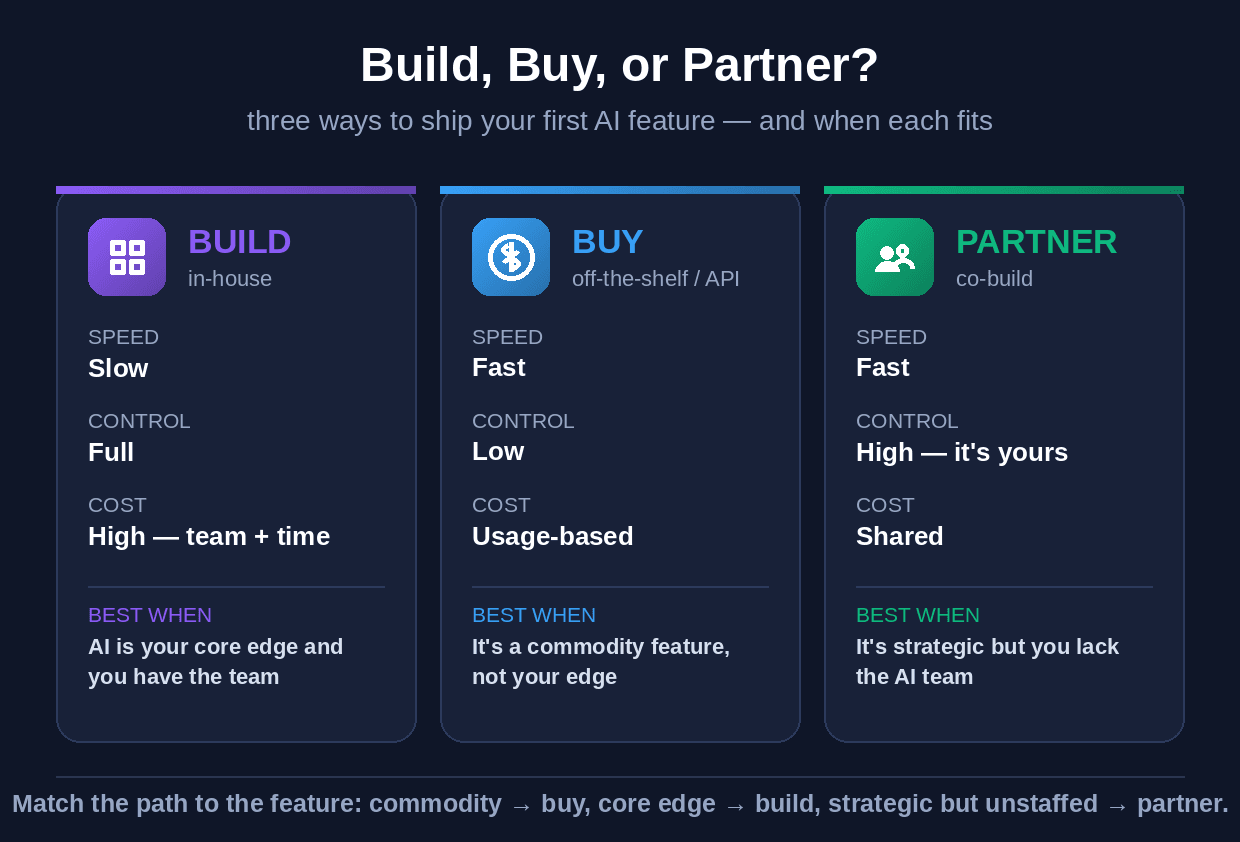
Build, buy, or partner — three ways to ship your first AI feature, and when each fits.
The Three Paths
1. Build (in-house) — Your own team designs and builds the AI feature from scratch. You get full control and own every detail — but it's the slowest and most expensive path, and it requires AI and ML talent that's hard to hire and expensive to keep. Building makes sense when the AI feature is the thing that sets you apart, and you have (or will invest in) the team to do it well.
2. Buy (off-the-shelf or API) — You plug in an existing tool or an AI API and ship fast. It's the quickest and cheapest way to start, and perfect for features that are table stakes rather than differentiators. The trade-offs: limited control, limited ability to tailor it to your product, and a cost that scales with usage — plus whatever you build this way, a competitor can usually buy too.
3. Partner (co-build) — You work with a technology partner who brings the AI expertise and builds the feature with you — and you own the result. You get much of the speed of buying with much of the control of building, and you don't have to hire an AI team to do it. The cost and risk are shared. Partnering fits when the feature is strategic to your product but you don't have the in-house capability to build it well or fast enough alone.
The Framework: Three Questions That Decide It
You don't need to agonize. Three questions route almost every first AI feature to the right path.
1. Is this feature your core differentiator? If the AI feature is central to why customers would choose you — the thing that becomes your edge — lean toward build or partner, because you want control and ownership of it. If it's a supporting feature customers expect but won't choose you for, lean toward buy.
2. Is it a commodity? If the capability is widely available and roughly the same no matter who provides it (basic transcription, generic chat, standard summarization), buy it — building or partnering on a commodity wastes time and money. If doing it well on your specific data or workflow is what creates value, don't buy a generic version.
3. Do you have the team? If the feature should be build-grade (core, not commodity) but you don't have the AI talent in-house — and can't hire it fast enough — that's exactly the gap partnering fills. It's how you get a differentiated, owned feature without waiting a year to staff up.
Your situation | The path | Why |
|---|---|---|
Commodity feature, not your edge | Buy | Fastest, cheapest; no reason to build |
Core edge + you have the AI team | Build | Full control of what sets you apart |
Strategic + no AI team to build it | Partner | Speed and ownership without hiring |
Not sure it'll even be used | Buy (cheap test) | Validate before you invest in building |
The Mistakes to Avoid
Two expensive errors account for most first-AI-feature regrets. Building a commodity: spending months and senior engineering time building something you could have bought in a week — because building felt more 'serious.' Buying your core differentiator: bolting a generic, off-the-shelf tool onto the exact capability that was supposed to set you apart, so your edge ends up identical to every competitor's. A third, quieter mistake: defaulting to build because you can, without asking whether the AI talent, timeline, and ongoing maintenance are really worth it for a first feature. Match the path to the feature, not to your instincts or your ego.
What to Do This Week
Write down the one AI feature you're considering shipping first, and run it through the three questions: Is it my core differentiator? Is it a commodity? Do I have the team to build it well? The answers will point you to build, buy, or partner — and usually it's obvious once you've written it down. Then do the cheap validation step regardless of path: before committing real money, confirm the feature is something users actually want, so you're not building, buying, or partnering on a feature nobody uses. That one page saves you from the most expensive version of this decision.
When Partnering Is the Right Call
For a lot of B2B SaaS teams, the first AI feature lands in the hardest spot on the framework: it's strategic enough that a generic bought tool won't do, but the company doesn't have an AI team to build it in-house — and hiring one to ship a single feature doesn't make sense. That's the gap the partner path exists for, and it's exactly what Wedigtech does: co-building AI features and products with B2B SaaS teams, bringing the AI and product expertise so you ship something differentiated and genuinely yours, fast, without staffing up a whole AI function first.
If you're weighing how to ship your first AI feature and the build-vs-buy-vs-partner call isn't obvious, that's a short conversation worth having. Book a call and we'll help you think it through against your specific feature.
Was this helpful?
Ready to architect your next stage of growth?
Partner with wedigtech and turn ambition into compounding, measurable outcomes.
More from Insights
View All

How to Find a Technology Partner for Your Mobile App Development in 2026
How to find a technology partner for mobile app development in 2026: the green flags to look for, the red flags to avoid, the exact process to shortlist and vet one, and the questions to ask.
Read More
How to Build an AI Business in 2026: The Founder's Blueprint
A founder's guide to building an AI business in 2026: the six-step blueprint, what AI-native really means, the traps to avoid, and how to start — from finding the right problem to building a data moat.
Read More
How Founders Are Saving 60% of Their Time With AI Automation and Agents
How founders are saving ~60% of their time with AI automation and agents — where the hours actually go, the exact automations that reclaim them, and how to start this week.
Read More