Aug 25, 2026

How D2C Brands Are Scaling Without Increasing Headcount
Two Brands, Same Revenue, Very Different Teams
Two D2C brands both hit the same monthly revenue this year. The first did it with a team that grew at every milestone — a hire for each new channel, each new market, each new product line. Payroll is now its largest fixed cost, and the margin that was supposed to expand with scale has quietly compressed instead. The second reached the same revenue with roughly half the people, and its margin is widening as it grows.
Same top line. Opposite structure. And the gap between those two businesses widens every quarter, because one is compounding and the other is just getting heavier.
This is the linear headcount trap, and it is the defining operational challenge for D2C brands in 2026. As INovaBeing's 2026 analysis describes it: revenue scales, headcount scales with it, and margin stays flat or shrinks — the business grows in size but not in structural strength. The brands breaking out are not working harder or hiring smarter. They are building an operational leverage layer. Here is how it works, and how to tell where you stand.
The Number That Tells You If You're Building Leverage or Just Cost
There is one metric that separates the two brands above, and you can calculate it in ten seconds: revenue per employee. It is the clearest proxy for operational efficiency there is, and the 2026 benchmarks are well established. The public DTC cohort median sits at $720,000 per full-time employee, the top quartile clears $1.2 million, and anything under $400,000 per FTE at $20M+ revenue is a yellow flag worth a hard org-chart review, according to Eightx's 2026 DTC headcount analysis.
The trajectory matters as much as the number. Revenue per employee climbs from roughly $100,000 at early stages to $300,000 and beyond at scale for brands that build leverage — and the ones that do share a common trait: they lean on automation and AI rather than headcount, according to Flint's 2026 revenue-per-employee research, which also found that AI reduced the growth of net new marketing hires by 18% between 2025 and 2026 while marketing output still grew 24%. More output, fewer hires. That is operational leverage in one sentence.
Revenue per employee (annual) | What it signals | The move |
Below $400K at $20M+ | Headcount grew ahead of revenue — margin compressing | Hard org-chart review; build the leverage layer |
$500K–$700K | Healthy operating band for $10M–$100M | Consolidate specialists into generalists + systems |
~$720K (cohort median) | Competitive, but not yet compounding | Push volume onto systems, not new hires |
$1.2M+ (top quartile) | Elite leverage — 5x output on the same team | Protect it: systems absorb the next stage of growth |
Run your own number: annual revenue divided by full-time headcount. Where you land tells you whether your next move should be a hire or a system. For most brands under the median, the honest answer is a system.
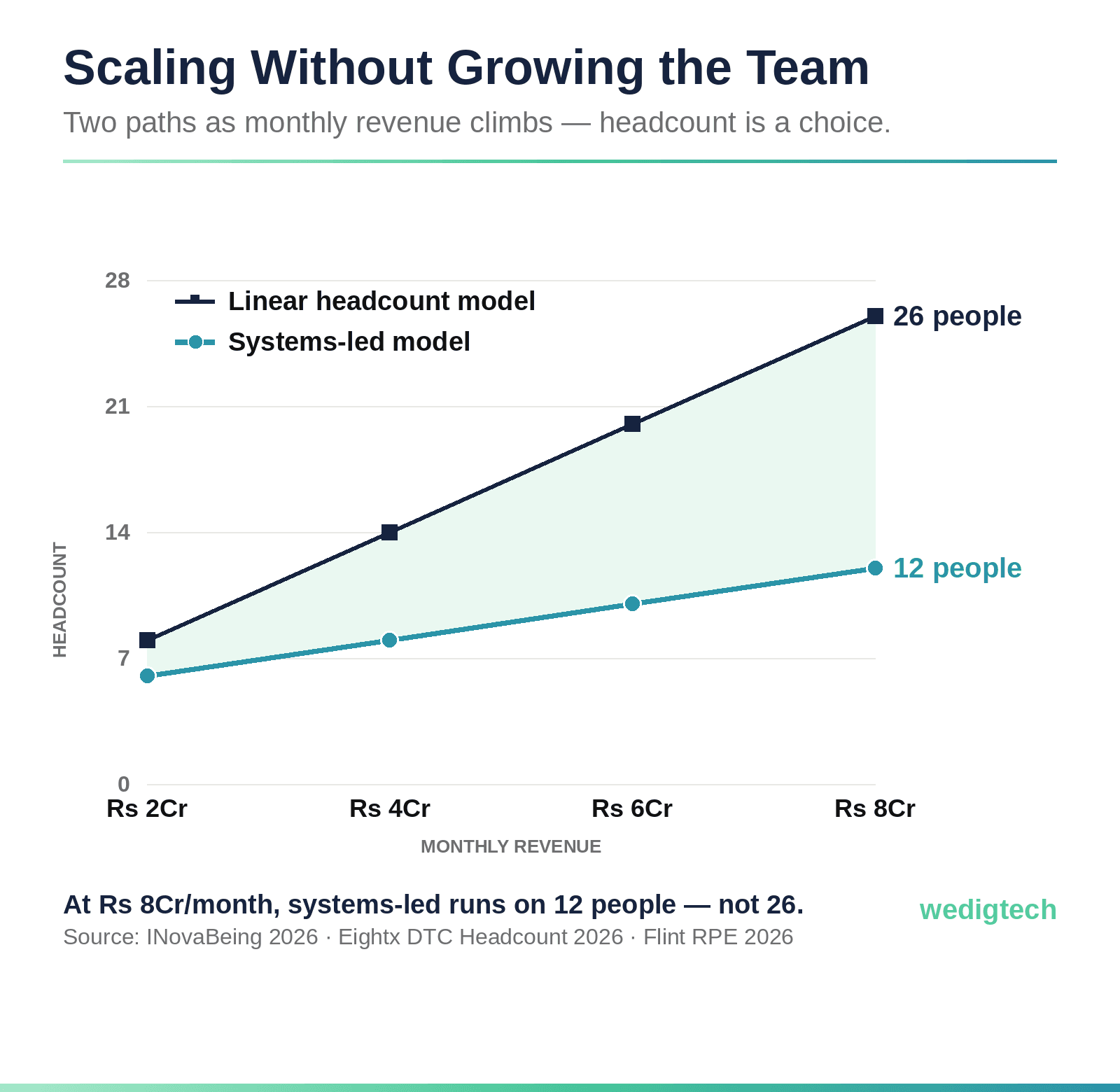
The two paths as revenue climbs — the widening gap is the margin.
The Four Levers That Scale Without Hiring
Operational leverage is not one tool. It is a layer built across the four functions that otherwise force a brand to hire as it grows. Here is where each lever replaces headcount with a system.
Lever 1 — Marketing execution
Competing in D2C now requires a volume of content no small team can produce manually — email, WhatsApp, social, blog, and endless ad-creative variations. AI compresses the three-to-four-person marketing execution team into a single operator running copy, sequencing, A/B tests, and personalised variants at machine speed, with the human on strategy and brand voice, according to INovaBeing (2026). The output scales with the customer base; the headcount does not.
Lever 2 — Customer operations
Support is where D2C brands hire most defensively. At scale, keeping response times low the manual way can mean 50+ support staff, according to AgentSolutions (2026). An AI support layer absorbs that volume — and across a 35-brand portfolio, pre-AI CX teams ran 2 to 3 times heavier than AI-augmented teams handling the same ticket volume today, according to Eightx (2026). Same service level, a third of the people.
Lever 3 — Inventory and operations
Inventory decisions, reorder triggers, and supplier coordination scale in complexity with SKUs and channels. A systems layer that forecasts demand and flags reorder points turns work that used to require an ops hire into automated alerts a founder approves — carrying less dead stock and fewer stockouts without adding a person.
Lever 4 — Revenue intelligence
The fourth lever connects the data a brand already generates — orders, engagement, ad signals — into personalisation and retention that a manual team could never run at volume. It is the difference between reacting to last month's numbers and acting on this morning's, without a data hire to produce them.
What the Model Looks Like at Scale
The outcome is measurable. A Shopify D2C brand doing Rs 3–5 crore monthly revenue can run at the operational output of a 15-person team with a 5–6 person team, and expand toward Rs 15 crore without a proportional headcount increase, according to INovaBeing (2026). The 7% of retailers who have fully scaled AI are running 5x the output with the same team. At the extreme, Monolit's 2026 analysis documents solopreneurs generating revenue comparable to teams five times their size.
For the Indian skincare brand INovaBeing profiles, the systems-led model avoids roughly Rs 8.5 lakh per month in headcount cost by the time it reaches Rs 8 crore in monthly revenue — money that stays in the business as margin rather than payroll. That is the compounding gap the chart above shows, expressed in rupees.
None of these brands are exceptional operators. They made one deliberate decision early: that volume growth would ride on systems, not on the org chart.
From the Linear Model to the Compounding One
The choice between hiring to grow and building leverage to grow is not made at Rs 10 crore, when payroll is already the biggest line and changing the model means restructuring the team. It is made earlier — while the founder is still close enough to the operations to design them, and before the headcount trap has closed.
Wedigtech's Operating System and Technology System are built to design that leverage layer for growth-stage D2C brands — mapping the four levers to a brand's specific operations, building the AI infrastructure that absorbs volume, and installing the oversight model that keeps quality high as the brand scales. Because Wedigtech takes equity in the outcome, the incentive is a business that compounds margin as it grows — not one that compounds payroll.
Was this helpful?
Ready to architect your next stage of growth?
Partner with wedigtech and turn ambition into compounding, measurable outcomes.
More from Insights
View All

How to Implement Project Management in ClickUp (Founder's Step-by-Step Guide)
A founder's step-by-step guide to implementing project management in ClickUp: how to structure your workspace, set statuses and views, build a dashboard, use ClickUp Brain AI, and set up AI agents.
Read More
How to Use AI for Marketing: A 90-Day Playbook for B2B SaaS
A 90-day, phase-by-phase playbook for using AI in B2B SaaS marketing: exactly what to implement in days 1-30, 31-60, and 61-90, which tools to use at each stage, and what to do yourself vs delegate to AI.
Read More
The AI Team Every D2C Brand Needs in 2026
Most D2C founders think AI means more tools. The ones growing fastest think differently. Here is the five-role AI team structure that replaces your hiring plan in 2026.
Read More