Aug 25, 2026
How a Retail Brand Built a Full Lead-to-Sale Automation in 90 Days
The Campaign Worked. Nobody Knew Why.
A growing retail brand ran a strong promotional campaign in Q3. Traffic was up, email opens were high, the social ads out-clicked anything before them. At the end of the quarter, revenue was flat — and nobody could explain it. Marketing knew the campaign performed. Sales knew the week was busy. But the connection between a click at the top of the funnel and a sale at the bottom was invisible. Attribution was a guess, repeat-purchase rate was untracked, and the pipeline had no visibility between 'interested' and 'paid.'
This is the operating reality for most retail businesses below $10M in revenue: marketing happens, sales happen, and the system that connects them doesn't exist. This piece is the build that closes that gap — the four components of a working lead-to-sale system, the exact 90-day plan to stand it up, and what to start on this week. It is not a lesson in retail marketing; it is the architecture and the actions.
The Four Components of a Working Lead-to-Sale System
A functioning lead-to-sale system has four parts that work together. Most retail brands have one or two. The ones that produce compounding revenue have all four — and the connection between them is where AI does the work no manual team can do consistently.
1. Capture. A defined way a prospect enters the system with enough data to personalise what comes next — not a newsletter signup, but a sequence that collects intent alongside the email: what they're looking for, how they arrived, what category they engaged with.
2. Nurture. Automated communication that moves a prospect from interested to ready-to-buy based on their behaviour, not a calendar. The sequence triggers on actions.
3. Conversion checkpoint. A defined moment where a prospect becomes sales-qualified and is treated differently from someone still deciding. This is where most retail brands leak revenue — there's no distinct treatment for the person two steps from buying.
4. Retention loop. Automated communication that starts the moment a sale completes and is built to turn a one-time buyer into a repeat customer. Without it, every sale ends a relationship. With it, every sale begins a more valuable one.
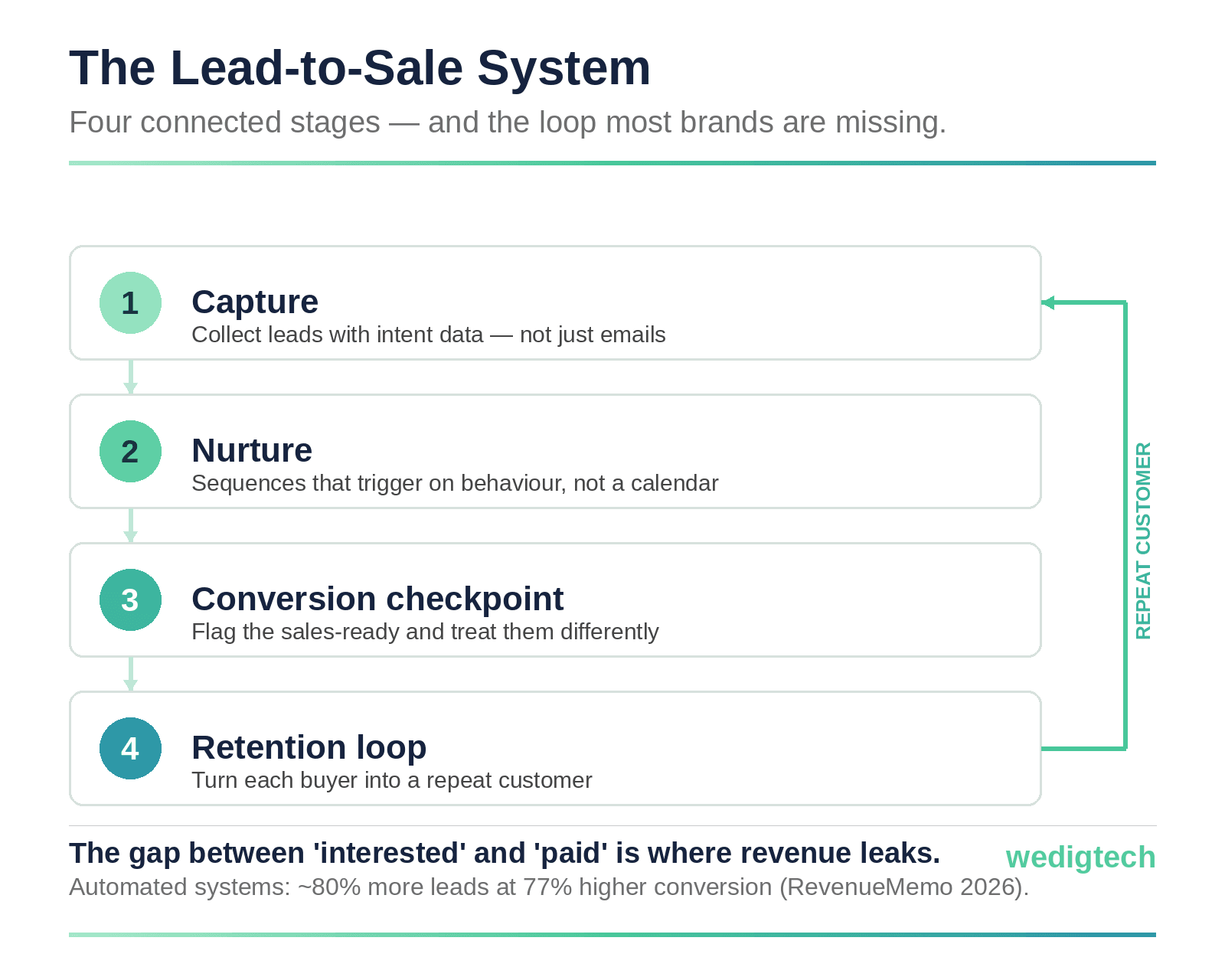
The four components — connected, with the retention loop feeding repeat customers back in.
Component | What it does | Tools typically used | The failure without it |
|---|---|---|---|
Capture | Collects qualified leads with intent data | CRM + lead forms + pop-up flows | An email list with no segmentation |
Nurture | Moves prospects based on behaviour | Email automation + behavioural triggers | One campaign sent to the whole list |
Conversion checkpoint | Identifies sales-ready leads | AI lead scoring + CRM stage rules | No line between warm and hot leads |
Retention loop | Converts buyers to repeat customers | Post-purchase email + SMS sequences | Every sale treated as a closed deal |
The 90-Day Build, Phase by Phase
The plan below assumes a brand starting from a basic email list, a working ecommerce platform, and no formal CRM. The sequence matters as much as the components — each phase builds the foundation the next one needs.
Days 1–30 — Foundation. Configure the CRM around the customer-journey stages the business actually uses. Rebuild lead-capture forms to collect intent data alongside contact details. Segment existing contacts by purchase history and engagement. This phase produces no automation — it produces the clean data automation can act on. (You cannot automate a journey you haven't defined.)
Days 31–60 — Sequences. Build and activate the behaviour-triggered nurture sequence for new leads. Build the post-purchase retention loop for the last 90 days of buyers. Define the conversion-checkpoint logic and set the CRM stages to trigger it automatically. By the end, new leads are moving through a structured journey and recent buyers are in a retention sequence.
Days 61–90 — Attribution and optimisation. Connect campaign spend to CRM-level outcomes and produce the first real revenue-attribution report — not platform-reported ROAS, but revenue traceable to identifiable leads in the CRM. Review the sequences against engagement data and adjust. By the end, the team can see which campaigns produce sales, not just clicks.
What to Do This Week
You don't need the full system to start closing the gap. Do these three things now. First, trace one real recent sale backwards — can you identify the exact campaign or sequence that produced it? If you can't, you've just found your attribution gap, and it's the reason budget decisions feel like guesses. Second, take your single highest-traffic capture point and add one intent question beyond the email field; that one field is what makes every downstream sequence personal instead of generic. Third, turn on the post-purchase retention email — the one that fires the moment a sale completes. It is the lowest-effort, fastest-compounding component of the whole system, and most retail brands simply don't have it live. These three cost almost nothing and each closes a specific leak.
What Changes at Month Four
The compounding effect doesn't show in month one. It shows at month four — once the retention loop has run, the nurture sequences have been refined against real engagement, and the attribution data has enough history to reveal which channels actually produce revenue. Marketing automation drives a 14.5% increase in sales productivity, according to Nucleus Research (2025), and in retail — shorter cycle, higher volume — the impact compounds faster: automated systems see roughly 80% more leads at 77% higher conversion, per data compiled by RevenueMemo (2026).
The brand in the opening scenario, after 90 days, got its first attribution report. It showed that 60% of the Q3 campaign revenue had come from two email sequences reaching prospects who'd visited the site twice without buying — while the social ads, which had consumed 40% of the budget, attributed to under 15% of actual revenue. That single insight shifted the Q4 allocation and produced a 28% higher return on the same spend. That is the operational leverage a connected system produces: not just efficiency, but decisions that were previously impossible.
Where Wedigtech Comes In
Building this connected system — the capture, the behaviour-triggered sequences, the AI scoring at the conversion checkpoint, the retention loop, and the attribution that ties it together — is an AI-led operations problem, and it is what Wedigtech does. Wedigtech is not a marketing agency running your campaigns; it builds and runs the intelligent lead-to-sale system underneath them, so acquisition, conversion, and retention connect and every budget decision becomes defensible. You keep owning the brand and the campaigns; Wedigtech builds and operates the system that turns their results into visible, compounding revenue.
And because Wedigtech's model is equity- and outcome-aligned, the incentive is a system that keeps improving after the 90 days — the attribution sharper, the sequences better, the retention loop compounding — not a project that ends at launch.
Was this helpful?
Ready to architect your next stage of growth?
Partner with wedigtech and turn ambition into compounding, measurable outcomes.
More from Insights
View All

How to Find a Technology Partner for Your Mobile App Development in 2026
How to find a technology partner for mobile app development in 2026: the green flags to look for, the red flags to avoid, the exact process to shortlist and vet one, and the questions to ask.
Read More
How to Prioritize AI Features for Your SaaS Product (2026 Roadmap)
An AI product roadmap for SaaS: exactly which AI features to build first, which to build next, and which to skip — plus the one test that tells you where any AI feature belongs.
Read More
How Smart Brands Use AI for Marketing in 2026 (Case Study + Playbook)
How new-age brands use AI for marketing — the six core plays, a deep case study of Spotify's AI marketing engine, the real learning for everyone else, and how to build it.
Read More