Sep 3, 2026

10 AI Agents That Grow a Financial Institution's Profit
For Financial Institutions, AI Agents Are Now the Clearest Profit Lever
Banks, lenders, and insurers are under a familiar squeeze: rising cost-to-serve, fraud and default losses, and compliance overhead all pressing on margin. AI agents — software that executes multi-step workflows across systems with minimal human intervention, not just chatbots — have become the clearest lever against all three. The numbers are already concrete: JPMorgan Chase has generated close to $1.5 billion in cumulative AI cost savings, and McKinsey estimates AI could cut banking cost categories by up to 70%, with a net industry effect of 15-20%, or $700-800 billion, according to analysis compiled by Neurons Lab (2026).
The useful question is not whether to deploy AI agents, but which ones move profit and in what order. This piece is that shortlist — ten agents, each mapped to a specific profit lever, with what it does, its documented impact, and how to put it to work. It's a deployment guide, not a trend overview.
Every agent below pulls one of three levers: it cuts cost, cuts losses, or grows revenue. Here they are.
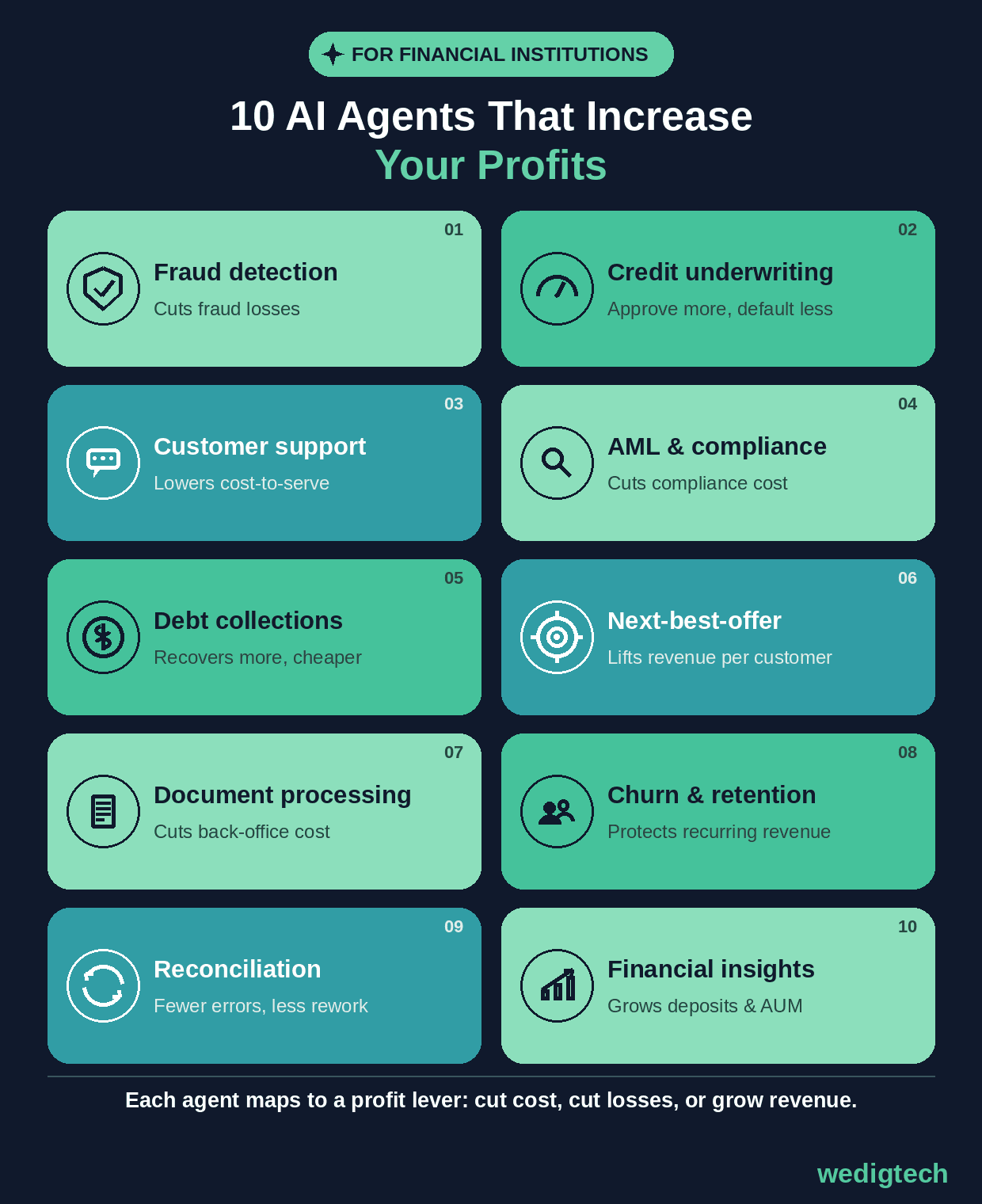
Ten AI agents, each mapped to a profit lever — cut cost, cut losses, or grow revenue.
The 10 Agents, and the Profit Each One Drives
# | AI agent | What it does | Profit lever + documented impact |
|---|---|---|---|
1 | Fraud detection | Flags anomalous transactions in real time | Cuts losses — stops ~92% of fraud; 42% of issuers saved $5M+ |
2 | Credit underwriting | Scores applications on a broader data picture | Cuts losses / grows revenue — +34% approval accuracy, lower defaults |
3 | Customer support | Resolves routine queries end to end | Cuts cost — handles 70-85% of inquiries at ~$0.72 saved each |
4 | AML & compliance | Monitors transactions, automates checks | Cuts cost — compliance costs down ~19-40% |
5 | Debt collections | Prioritises and personalises outreach | Cuts losses — recovers more per account at lower cost |
6 | Next-best-offer | Recommends the right product per customer | Grows revenue — lifts revenue per customer via cross-sell |
7 | Document processing | Extracts data from forms and statements | Cuts cost — one deployment saved 360,000 hours a year |
8 | Churn & retention | Predicts at-risk customers, triggers action | Grows revenue — protects recurring deposits and premiums |
9 | Reconciliation | Matches transactions and ledgers | Cuts cost — fewer errors, less back-office rework |
10 | Financial insights | Delivers tailored insights to customers | Grows revenue — deeper engagement, deposits, and AUM |
The impact figures are drawn from live deployments: fraud detection now stops roughly 92% of fraudulent transactions before they clear (ABA Banking Journal, 2026); AI credit-risk models improved loan-approval accuracy by 34% in mid-size banks and compressed 3-5 day approvals to minutes (data compiled by fwdslash, 2026); and support agents handle the bulk of routine inquiries at a fraction of the cost of a live agent. Across functions, institutions deploying AI agents report an average 3.5x ROI and roughly 35% cost reduction (KPMG via Neurons Lab, 2026).
Which to Deploy First
You do not deploy ten agents at once. The sequencing question has a clear answer from adoption data: the highest-value, most-proven agents are fraud detection and customer support, which is exactly where banks are concentrating — the top processes being moved to AI agents are customer service (75%), fraud detection (64%), loan processing (61%), and onboarding (59%), according to the Capgemini World Cloud Report in Financial Services 2026.
Start with fraud detection. It has the clearest, fastest ROI in the entire list — it directly reduces a loss line, and the impact is measurable within weeks.
Then customer support. It removes the largest, most repetitive cost from operations and improves service at the same time.
Then underwriting and compliance. These are higher-stakes, so they follow once the operating model and human oversight are proven — but they carry large loss- and cost-reduction upside.
The three profit levers also guide prioritisation: if margin pressure is on cost, lead with support, document processing, and reconciliation; if it's on losses, lead with fraud, underwriting, and collections; if it's on growth, lead with next-best-offer, retention, and insights.
How to Deploy an Agent Well
Whichever agent goes first, the deployment pattern is the same. Connect the data the agent needs into one place (transactions, customer records, application data), because an agent can only act on data it can reach. Define the workflow and its guardrails explicitly, including the human-approval checkpoint — in regulated finance, the agent proposes and executes within limits, and a person signs off on the consequential decisions until trust and audit trails are established. Instrument the outcome from day one — the loss rate, the cost per interaction, the approval accuracy — so the profit impact is visible and the model improves on real results.
What to Do This Week
Pick the single profit lever under the most pressure right now — cost, losses, or growth — and choose the one agent from that group with the clearest measurable target. If it's losses, that's almost always fraud detection: pull last quarter's fraud-loss and false-positive numbers, because those two figures are both your business case and your baseline. Then confirm where the transaction and customer data that agent would need currently lives and whether it can be reached from one place. Those two steps — a quantified target and a data check — turn 'we should use AI' into a specific, fundable first deployment, and they take an afternoon.
Building These Into the Operation
Any one of these agents will move a number. The larger gain comes when they're built as a connected system — the fraud agent, the underwriting agent, and the collections agent sharing a view of the customer, each firing with full context — rather than ten disconnected tools. That connected, governed layer is the difference between a pilot that saves a little and an operation whose cost and loss lines keep falling.
Standing that up reliably — the agents, the data foundation beneath them, and the human-oversight model regulated finance requires — is an AI-led operations problem, and it's the kind of build Wedigtech takes on with institutions; the ten agents and the deploy order above are the same whether you build them in-house or with a partner. If it would help to map these to your own institution — which lever to pull first, what to build, and how to keep a person in the loop where it matters — that's a short conversation worth having, and you can book a call to walk through it.
Was this helpful?
Ready to architect your next stage of growth?
Partner with wedigtech and turn ambition into compounding, measurable outcomes.
More from Insights
View All

Build AI Products and Operations Without Fronting the Cost: The Wedigtech Model
Most businesses fund 100% of their technology upfront and carry all the risk. Wedigtech's co-investment model is different: you invest ~30%, Wedigtech invests ~70%, and economics align to the value created.
Read More
The Best AI Tools to Automate B2B SaaS RevOps in 2026
The best AI tools to automate B2B SaaS RevOps in 2026 — the full stack by layer, from CRM and enrichment to forecasting and automation, with what AI does in each and where to start.
Read More
How to Find a Technology Partner for Your Mobile App Development in 2026
How to find a technology partner for mobile app development in 2026: the green flags to look for, the red flags to avoid, the exact process to shortlist and vet one, and the questions to ask.
Read More