Aug 25, 2026

Build AI Products and Operations Without Fronting the Cost: The Wedigtech Model
Why Does Building Technology Still Mean Carrying All the Risk?
There is an assumption underneath most technology decisions that is rarely questioned: if you want to build something, you pay for all of it upfront, carry the risk, and the firm you hired is paid whether or not the result creates value. For a large enterprise, that is workable. For a growth-stage business with finite capital and no room for a seven-figure mistake, it is often the single reason a worthwhile initiative never starts.
This article is about a different economic relationship — not a cheaper way to buy development, and not a way to defer the bill, but one where the firm building the technology invests alongside you and is paid primarily from the value the technology creates. It is the model Wedigtech is built around, and the thinking is worth understanding whether or not you ever work with us.
The Real Problem Isn't Cost — It's Paying Before You Know the Return
Technology requires investment before it produces anything. That is the nature of building, not a flaw software firms invented. The difficulty is where the risk sits:
- You pay the full cost before knowing how much value — if any — the technology will create.
- Traditional vendors are compensated for delivery, not for the business outcome.
- The entire gap between what the technology costs and what it returns rests on you alone.
- For a growth-stage company, that risk is often prohibitive — and worthwhile initiatives stall before they start.
A firm paid to deliver a defined scope is entitled to be paid for it; this is not a criticism of that model. But the ambition is rarely the constraint. The structure of the investment is.
A Different Way to Build: Investing Alongside You
Consider what changes if the firm building the technology invests in it with you — you fund a portion, your partner funds the rest, and your partner is repaid from the value created once it is working. For a qualifying opportunity, that is the Wedigtech model:
- You invest ~30% of the initial build cost.
- Wedigtech invests ~70% of the initial build cost.
- Wedigtech also contributes the capability that decides whether it succeeds — technology strategy, AI expertise, product thinking, design, engineering, and execution.
- Both parties are economically invested in the same outcome.
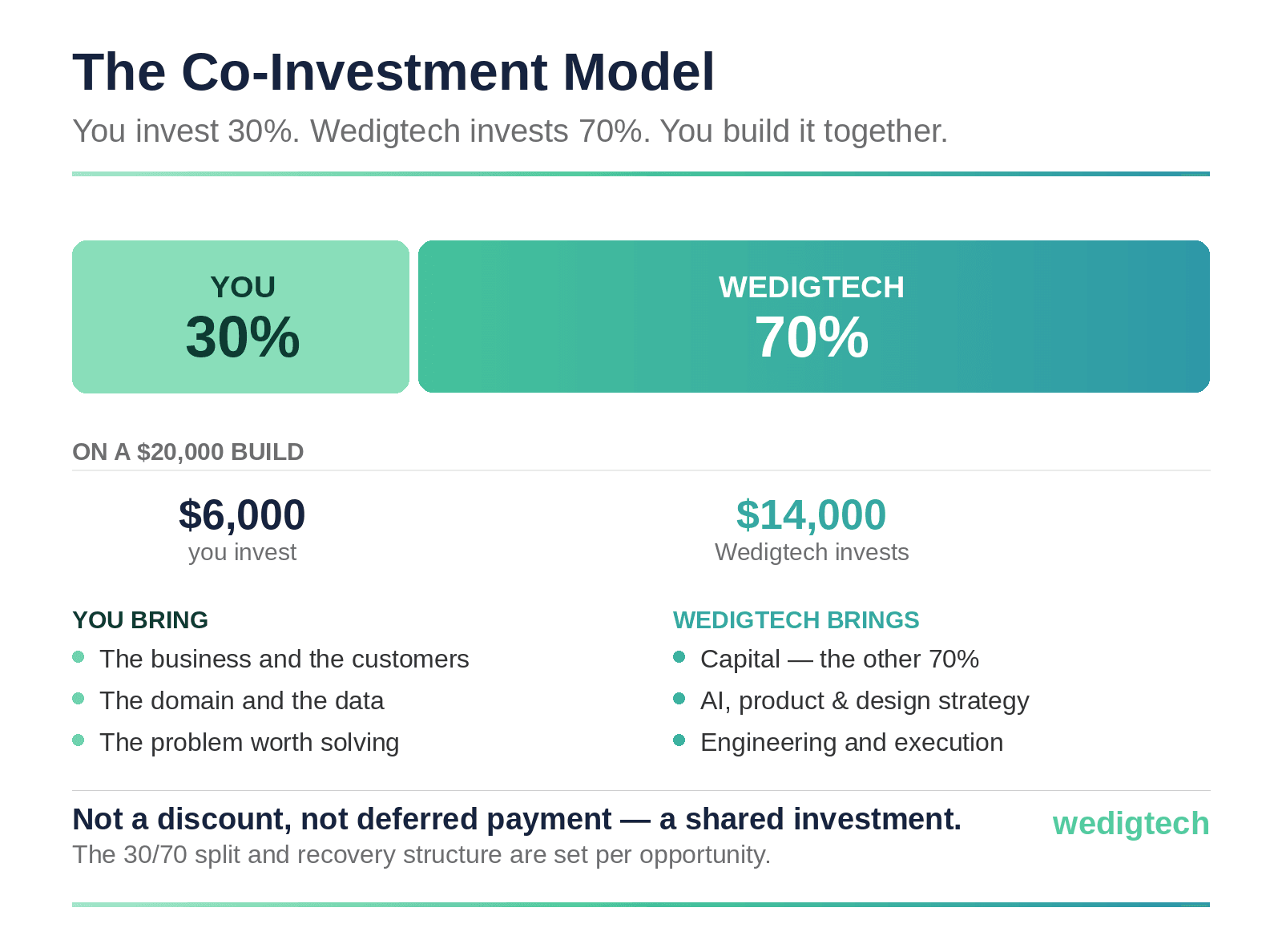
The co-investment model — you invest ~30%, Wedigtech invests ~70% plus its capability.
Two distinctions matter:
- It is not a discount — Wedigtech is not doing most of the work for free; it is investing most of the cost for a share of the value.
- It is not deferred payment — there is no invoice waiting at the end. It is a co-investment, and that is the whole point.
What Wedigtech Builds
Wedigtech co-invests in two kinds of capability. Both create enterprise value; they differ in where the value shows up.
A. AI Product Innovation — something you take to your market
- AI-powered products and product capabilities
- Customer-facing applications, platforms, and portals
- SaaS products and digital products
- New technology-enabled business lines
The technology becomes something you sell — a new revenue source and a durable asset, not just an internal tool.
B. Intelligent Operations — a business that runs better
- AI-powered internal operating systems, intelligent workflows, and automation
- Decision intelligence and customer operations
- Productivity and management-intelligence systems
- Broader AI capability-building
The value is a stronger business — lower cost to operate, more output from the same team, faster and better decisions.
What matters is not which category an initiative falls into, but whether the capability can create enough measurable value to justify co-investing in it.
Why the Model Is Structurally Different
The difference is not quality or speed — capable firms exist under both models. It is structural: who carries the risk, and what each party is incentivised to produce.
Traditional engagement | The Wedigtech partnership | |
|---|---|---|
Upfront capital | Business funds 100% | Business ~30%; Wedigtech ~70% |
Risk | Carried by the business alone | Shared — both have capital at stake |
Incentives | Vendor paid for delivery | Wedigtech paid from value created |
Relationship | Client and vendor | Co-investors in one outcome |
Duration | Ends at delivery | Continues through value creation |
Economics | Fixed fee for a defined scope | Aligned to the value produced |
Success | The build was delivered | The business created measurable value |
Traditional success is defined as delivery; Wedigtech success is defined as value. Neither is wrong — but for a business betting on an uncertain outcome, having your partner's economics tied to that same outcome is a meaningful difference.
How the Economics Work
On a $20,000 build, the business contributes $6,000 (its 30%) and Wedigtech invests the remaining $14,000, plus the strategy, design, and engineering to build it. How does Wedigtech recover the $14,000? There is no single formula — it depends on the value created. Economics may align through:
- Revenue participation — the technology generates new or incremental revenue, and Wedigtech shares in it.
- Cost-savings or performance participation — the value is a measurable reduction in cost or improvement in a business metric.
- Equity participation — Wedigtech takes a stake in the enterprise value it helps build.
- Hybrid structures — a blend of the above, matched to the opportunity.
Most structures are customised and often blended. The constant is not the mechanism but the principle: Wedigtech's return is tied to the value created, so it earns as the business does — and not before.
When Value Can't Be Traced to a Line of Revenue
Not all technology value shows up as revenue you can point to — and this matters. An intelligent operating system might make a team more productive, reduce errors, speed decisions, lower support costs, and release capacity. All real value; none of it a clean, separately attributable revenue line. Value does not have to be revenue to be measured. It can be measured through:
- Verified cost savings
- Documented productivity gains
- Capacity released and redeployed
- Efficiency improvements
- Customer retention
- Overall business performance and strategic value
Where a direct revenue share is not the right instrument, these become the basis for how value is recognised and economics aligned. The discipline is to measure honestly — not to pretend all value is revenue.
How Wedigtech Decides What to Invest In
Because Wedigtech invests its own capital, it is selective and does not take on every opportunity. A few questions decide the fit:
- Is the business real — a proven model, real revenue, a genuine customer base?
- Is the opportunity meaningful and large enough to build for?
- Can AI or technology materially — not marginally — improve the business?
- Is there a real capability gap the business can't easily close on its own?
- Can the value created be measured?
- Is leadership genuinely committed to building and scaling it?
- Is this a long-term opportunity, not a one-off request?
Underneath sits one discipline: whether the capability can create a credible path toward roughly 3–5× the invested capital in economic value. This is not a promised return — it is the internal bar for whether an opportunity is worth Wedigtech's own money and capability. Without a credible path, it isn't the right opportunity for either side.
Who the Model Is For
The model is built for growth-stage businesses — typically:
- Revenue in roughly the $300K–$2M range
- A proven model, a growing customer base, and the ambition to scale
- Founder- or CEO-led, or with strong executive ownership
- Early in AI adoption, exploring what's possible
- A real technology or operational opportunity beyond current internal capability
But revenue is only one criterion — and not the most important. The stronger one is value-creation potential: a value gap, where an underdeveloped technology or AI layer could unlock substantially more value than it costs to build. The model is deliberately industry-agnostic: D2C and B2B SaaS are examples, not the definition. The common denominator is enterprise value creation.
Who It Is Not For
Being clear about where the model does not fit is part of taking it seriously. It is not the right approach for:
- Commodity software development, one-off websites, or simple feature requests
- Initiatives where the business value is unclear or can't reasonably be measured
- Companies looking primarily for cheap development — this is an investment, not a discount
- Opportunities without genuine executive ownership, or a single project rather than a capability worth scaling
These are different needs, not lesser ones. The co-investment model is designed for a specific situation — a real business, a real value gap, and a shared willingness to build and measure.
The Partnership Journey
Discover → Qualify → Define → Invest → Build → Launch → Measure → Scale
- Discover — understand the business, the opportunity, and the value gap.
- Qualify — apply the investment discipline — is there a credible path to measurable value?
- Define — agree what will be built, the value it should create, and how it will be measured.
- Invest — structure the co-investment — the ~30/70 split and how economics align to value.
- Build — build the AI product or intelligent operations together.
- Launch — put it into the business, or into the market.
- Measure — track the value actually created against what was defined.
- Scale — extend what works and deepen the partnership over time.
The point of the arc: it does not end at launch. It continues into measurement and scale — where the value, and the shared return, actually accrue.
The Bigger Idea: Technology as an Asset, Not an Expense
Businesses have long treated technology as something they buy — an expense to procure, budget, and depreciate. That made sense when technology was a supporting cost. AI has changed what technology can do: it can reshape products, operations, customer experiences, decision-making, and in some cases the business model itself.
Technology of that consequence is not really an expense; it is an asset — something that creates durable enterprise value and helps determine which businesses pull ahead. And assets worth having are usually worth investing in, not simply purchasing. That is the idea the co-investment model is built on: if technology can be an asset, the firm that builds it can invest alongside the business and share in the value. Not selling development — investing in building it.
Think your business has an opportunity worth building together?
If there is a real value gap — a meaningful opportunity and an underdeveloped technology or AI layer that could unlock substantially more value than it costs to build — it is worth a conversation to see whether a co-investment partnership fits. Explore a Wedigtech partnership.
Was this helpful?
Ready to architect your next stage of growth?
Partner with wedigtech and turn ambition into compounding, measurable outcomes.
More from Insights
View All

How Smart Brands Use AI for Marketing in 2026 (Case Study + Playbook)
How new-age brands use AI for marketing — the six core plays, a deep case study of Spotify's AI marketing engine, the real learning for everyone else, and how to build it.
Read More
100+ AI Tools for B2B SaaS Founders (Organised by Use)
A categorised directory of 100+ AI tools for B2B SaaS founders — for content, SEO, sales, support, coding, automation, analytics and more — with what each one is best for.
Read More
The AI Features Every Modern Pharma App Should Have
The AI features a pharma company can build into its app — from smart adherence and an AI assistant to drug-interaction safety and risk prediction — the business value of each, and how to build them compliantly.
Read More