Aug 25, 2026

20 AI Agents That Replace Manual Work in D2C — And What Each One Does
This Is Not a Tool List
Most AI roundups list products. This is different. Every agent below maps to a specific job that a D2C brand currently assigns to a person — or does badly because no person has time for it. Each one comes with what it replaces, what it actually does in production, and the result you can expect when it is deployed correctly.
The question is not whether these agents exist. They do, and the brands using them are pulling away from the ones that aren't. The question is which ones your brand deploys first and in what order.
68% of retailers plan to adopt agentic AI in the next 12 to 14 months, according to Deloitte's 2026 Retail Outlook Report. The brands that have already deployed are not waiting. The gap between the two groups widens every quarter these agents are running.
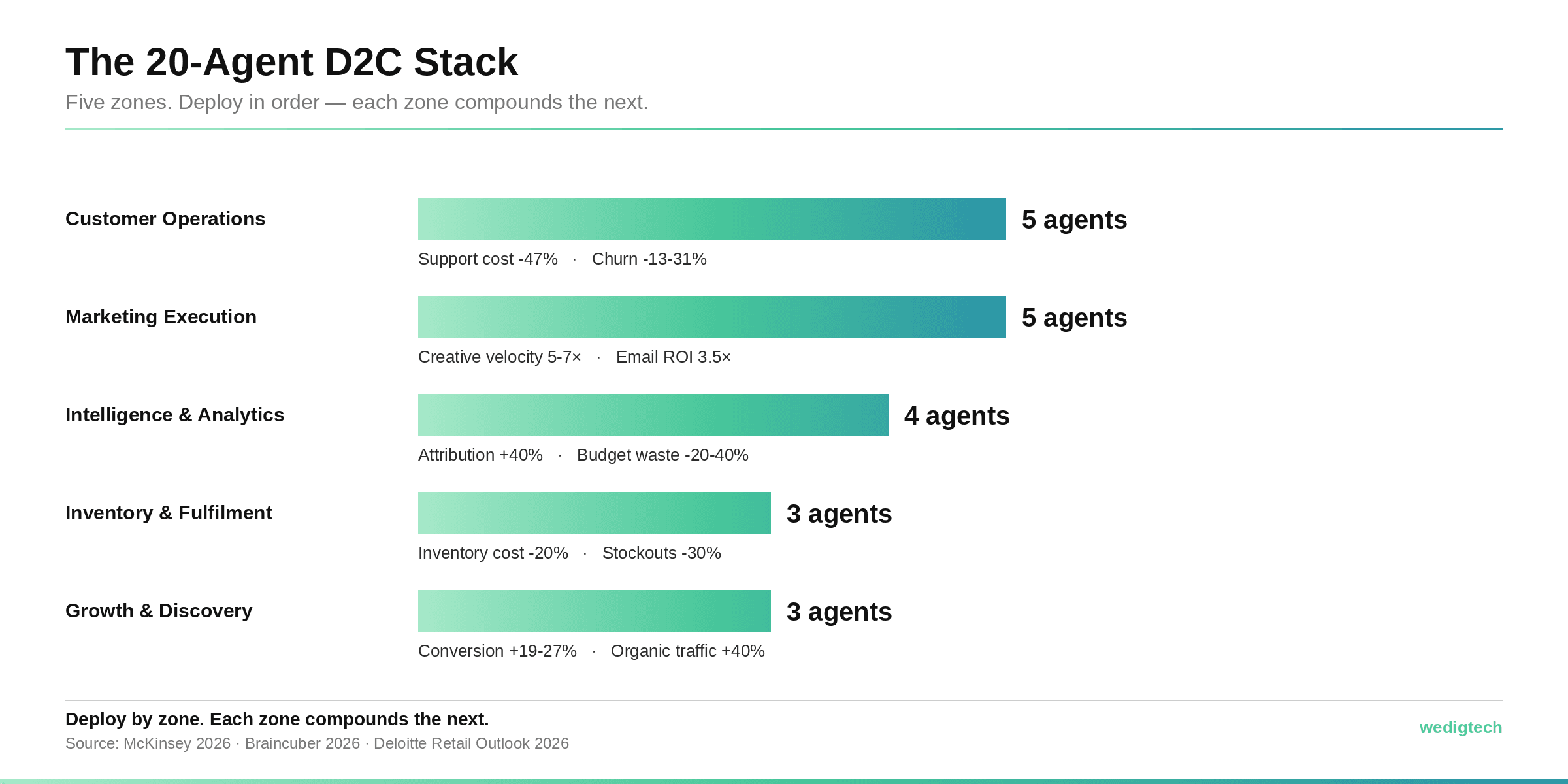
The 20-Agent D2C Stack at a Glance
# | Agent name | Zone | Replaces | Result |
01 | Customer support agent | Customer ops | Support team first-response | 70–80% ticket deflection |
02 | Returns and refund agent | Customer ops | Manual returns processing | Automated end-to-end resolution |
03 | Churn prediction agent | Customer ops | Manual cohort review | Churn -13–31% |
04 | Post-purchase retention agent | Customer ops | Manual email follow-up | Repeat rate +15–25% |
05 | WhatsApp commerce agent | Customer ops | Human DM responses | 24/7 conversational selling |
06 | Ad creative agent | Marketing exec | Creative team first drafts | 5–7x creative velocity |
07 | Email sequence agent | Marketing exec | Manual campaign sends | 3.5x email ROI |
08 | SEO and AEO content agent | Marketing exec | Manual blog and PDP writing | 100 descriptions in 15 min |
09 | Social content agent | Marketing exec | Social media manager execution | Daily content at brand voice |
10 | UGC and review agent | Marketing exec | Agency-managed UGC briefs | Automated brief + follow-up |
11 | Attribution intelligence agent | Intelligence | Manual cross-platform reporting | Budget waste -20–40% |
12 | Demand forecasting agent | Intelligence | Planner gut and spreadsheet | Forecast accuracy +90% |
13 | Competitive intelligence agent | Intelligence | Manual competitor monitoring | Daily signal digest |
14 | Pricing optimisation agent | Intelligence | Manual price reviews | Margin +3–8% per SKU |
15 | Customer LTV scoring agent | Intelligence | Segment-level LTV estimates | Cohort-level LTV accuracy |
16 | Inventory reorder agent | Inventory & ops | Manual stock checks | Stockout events -30% |
17 | Dead stock alert agent | Inventory & ops | Monthly ops review | Working capital freed |
18 | Logistics exception agent | Inventory & ops | Manual NDR and delay chasing | RTO rate reduction |
19 | AI search discovery agent | Growth | SEO team and PDP optimisation | Conversion at 12.3% vs 3.1% |
20 | Influencer matching agent | Growth | Manual influencer research | 7–12x ROI vs traditional ads |
Zone 1 — Customer Operations (Agents 01 to 05)
This is the highest-volume zone and the fastest ROI. Every D2C brand has a support problem. Most solve it by hiring. The agents below solve it without hiring — and without sacrificing resolution quality.
01. Customer Support Agent
Replaces: Human first-response across email, WhatsApp, and chat
Handles order status, returns queries, shipping updates, product FAQs, and policy questions autonomously across every channel. Pulls live data from Shopify and the OMS. Escalates only when human judgment is genuinely required.
Result: 70–80% ticket deflection. Ticket resolution cost drops from $7.40 to $0.62 per contact (McKinsey 2026). Support team refocuses on relationship-critical conversations.
02. Returns and Refund Agent
Replaces: Manual returns processing handled by ops team
Validates return eligibility against policy, issues RMA numbers, initiates refunds or replacements, updates the OMS, and sends tracking confirmation — without a human touching it. Handles the predictable 70% of returns end to end.
Result: Returns resolution time from days to minutes. Ops team handles only exceptions and policy disputes.
03. Churn Prediction Agent
Replaces: Manual cohort reviews or no churn monitoring at all
Scores every buyer in the database on churn risk using behavioural signals — purchase frequency, recency, engagement decline, channel activity. Surfaces the at-risk cohort weekly. Triggers retention sequences before the customer has decided to leave.
Result: Churn rates drop 13–31% with AI-based early intervention (Coupler.io 2026). Conversions from at-risk cohorts rise 9–20%.
04. Post-Purchase Retention Agent
Replaces: Calendar-based email sequences or manual follow-ups
Triggers personalised post-purchase flows based on what was bought, when, and the buyer's previous order history. Replenishment reminders, cross-sell at the right moment, win-back when engagement drops. Runs without human scheduling.
Result: Post-purchase AI flows deliver the fastest payback of any D2C automation deployment — most brands see ROI within 60 to 90 days (Project Supply 2026).
05. WhatsApp Commerce Agent
Replaces: Team member managing DMs, broadcast lists manually
Handles product discovery, order confirmation, shipping updates, return requests, and personalised recommendations through WhatsApp. Remembers the customer's purchase history across every conversation. Supports multiple languages for Indian D2C brands.
Result: 24/7 conversational commerce without a DM management hire. Buyers who interact via WhatsApp agent show materially higher repeat purchase rates than email-only contacts.
Zone 2 — Marketing Execution (Agents 06 to 10)
Marketing execution is where most D2C teams are bottlenecked. The volume of content the channel requires in 2026 — five to seven new ad creatives per week, daily social content, weekly email sends, product descriptions for every SKU — cannot be produced manually at competitive speed. These agents do not replace marketing strategy. They replace the execution that consumes the team's time before strategy ever gets addressed.
06. Ad Creative Agent
Replaces: Creative team producing ad variants manually
Generates concept variations, ad copy, static and video scripts from a product URL and brand brief. Tests 15 to 30 variants simultaneously. Identifies which creative elements — hook, visual treatment, CTA — drive performance and generates the next batch based on winning signals.
Result: 5–7x creative output per week. Meta CPMs are up 38% year-over-year (Digital Applied 2026). The brands winning the auction are the ones with more creative surface area, not better targeting.
07. Email Sequence Agent
Replaces: Marketing team manually building and scheduling campaigns
Builds behavioural email sequences triggered by buyer actions: browse abandonment, first-purchase, replenishment window, win-back inactivity. Segments by purchase history and engagement signals. Runs without manual send decisions.
Result: 3.5x higher ROI vs manual campaign sends (Braincuber 2026). Email marketing returns $42 per $1 spent at optimised deployment (HubSpot 2026 Marketing Statistics).
08. SEO and AEO Content Agent
Replaces: Content team writing product descriptions and blog articles
Generates SEO-optimised product descriptions from raw spec data. Writes structured blog content optimised for both traditional search and AI answer engines — ChatGPT, Perplexity, Google AI Mode. 37% of product discovery now starts with AI assistants. Your content must be readable by both humans and AI.
Result: 100 product descriptions generated in 15 minutes vs 25–33 hours manually (Ayatas 2026). Traffic from AI engines to retail sites grew 4,700% year-over-year (Adobe 2025).
09. Social Content Agent
Replaces: Social media manager producing captions, stories, Reels briefs
Generates daily social content — captions, Reel scripts, story copy, carousel text — in brand voice from a style guide. Schedules and adapts content per platform. Identifies trending formats and applies them to brand messaging.
Result: Daily content output without a dedicated social hire. Creative consistency across channels without the briefing overhead.
10. UGC and Review Agent
Replaces: Agency or team member managing creator briefs and follow-ups
Identifies UGC creators from the brand's existing buyer base, generates personalised outreach and briefs, manages follow-up sequences, and collects content. Monitors review platforms for new responses requiring attention.
Result: UGC acquired from existing buyers at a fraction of agency cost. Review response time reduced from days to hours.
Zone 3 — Intelligence and Analytics (Agents 11 to 15)
This zone turns data into decisions. Most D2C founders have data. Very few have intelligence — numbers that tell them what to do next rather than what happened last week. These agents close that gap.
11. Attribution Intelligence Agent
Replaces: Manual reporting across Meta, Google, Shopify, and email
Unifies campaign data across all platforms into a single daily performance digest. Applies multi-touch attribution to surface which channels are actually driving revenue — not which ones claim the most credit. Flags budget allocation anomalies.
Result: Budget waste reduced 20–40% (LayerFive 2026). Brands measuring only platform ROAS systematically overspend on paid by the same margin.
12. Demand Forecasting Agent
Replaces: Spreadsheet-based demand planning or founder intuition
Forecasts SKU-level demand based on sales velocity, seasonality, trending signals, promotional calendar, and social momentum. Flags which SKUs will stockout and which are accumulating dead stock before the problem is visible in the warehouse.
Result: Inventory cost reduced up to 20% (EComposer 2026). One D2C brand averted $87,000 in dead stock through AI-flagged forecast data nine weeks earlier than manual review would have caught it (Braincuber 2026).
13. Competitive Intelligence Agent
Replaces: Manual competitor monitoring across websites, ads, and social
Monitors competitor pricing, product launches, ad creative changes, review sentiment, and promotional activity. Surfaces a weekly digest of competitive signals with relevance to the brand's positioning and live campaigns.
Result: Strategic decisions informed by current competitive landscape rather than lagged anecdotal observation.
14. Pricing Optimisation Agent
Replaces: Manual price reviews or static pricing set at launch
Analyses demand elasticity, competitor pricing, margin targets, and inventory levels to recommend optimal pricing per SKU. Adjusts recommendations as conditions change — promotional windows, stockout risk, competitive moves.
Result: Margin improvement of 3–8% per SKU reported by D2C brands using AI dynamic pricing. Prices reflect real-time conditions rather than last quarter's decision.
15. Customer LTV Scoring Agent
Replaces: Blended LTV calculations that mask cohort variation
Calculates LTV at the cohort level — by acquisition channel, first product, first month, geography — rather than as a blended average. Surfaces which cohorts are compounding and which are single-purchase. Informs acquisition budget allocation per channel.
Result: Acquisition spend reoriented toward channels producing the highest-LTV buyers rather than highest-volume buyers. Blended LTV averages describe no real customer — cohort LTV describes every one.
Zone 4 — Inventory and Fulfilment (Agents 16 to 18)
Inventory is where D2C margin dies quietly. Dead stock ties up working capital. Stockouts lose sales that marketing paid to generate. Logistics exceptions create the customer complaints that churn produces. These three agents address all three.
16. Inventory Reorder Agent
Replaces: Manual stock checks, supplier emails, purchase order creation
Monitors stock levels against sales velocity and lead times in real time. Triggers reorder recommendations at the calculated safety stock threshold. Drafts purchase orders for approval. Updates the system when stock arrives.
Result: Stockout events reduced 30% on average. Working capital not tied up in over-ordered SKUs. Founder time spent approving decisions rather than discovering problems.
17. Dead Stock Alert Agent
Replaces: Monthly ops review or end-of-season write-off
Tracks SKU-level turnover rates against category benchmarks. Flags SKUs accumulating inventory below their healthy turn rate 6 to 10 weeks before they become a write-off risk. Surfaces promotional or bundling options to clear position.
Result: Working capital recovered before dead stock is written off. Prevents the cycle of over-ordering that compounds with each launch.
18. Logistics Exception Agent
Replaces: Ops team chasing NDRs, delays, and failed deliveries manually
Monitors every active shipment for delay signals, NDR flags, and delivery failure patterns. Triggers automated customer notifications, rescheduling prompts, and carrier escalations before the customer contacts support.
Result: RTO rates reduced up to 54% in optimised deployments (ClickPost 2026). Customer-initiated support contacts from logistics issues drop significantly when the agent communicates proactively.
Zone 5 — Growth and Discovery (Agents 19 to 20)
The final zone is where AI agents are creating entirely new growth channels — ones that did not exist at meaningful scale two years ago. These are the agents building the next phase of D2C growth, not optimising the last one.
19. AI Search Discovery Agent
Replaces: Traditional SEO team optimising for Google blue links
Optimises product pages, descriptions, and brand content for AI search engines — ChatGPT, Perplexity, Google AI Mode, Amazon Rufus. Structures content so AI assistants can read, parse, and recommend the brand's products to buyers asking natural language queries.
Result: Brands with AI-search-optimised product pages convert at 12.3% vs 3.1% for non-optimised pages (Braincuber 2026). AI-influenced 20% of global online sales over the 2025 holiday season (Salesforce).
20. Influencer Matching Agent
Replaces: Manual influencer research, DM outreach, rate negotiation
Analyses the brand's buyer database to identify existing customers with creator profiles that match target audience characteristics. Scores creator fit on audience demographics, engagement rate, and category alignment. Generates personalised outreach and brief.
Result: D2C brands using AI-matched influencer programs report 7–12x ROI versus traditional advertising channels (Ancorrd 2026). The highest-converting creator partnerships come from existing buyers — people who already believe in the product.
Which Agents to Deploy First
The 20 agents above represent a complete D2C AI stack. No brand deploys all 20 at once. The priority sequence below is determined by time-to-ROI and the data dependency each agent carries.
Priority | Agent | Why first | Time to ROI |
1st | Customer support agent (01) | Highest volume, lowest data requirement, immediate cost reduction | 2–4 weeks |
2nd | Email sequence agent (07) | Works on existing list, behaviour triggers from Shopify data | 4–8 weeks |
3rd | Attribution intelligence agent (11) | Fixes budget waste before scaling spend further | 4–6 weeks |
4th | Post-purchase retention agent (04) | Highest LTV impact, runs on first-party data | 6–10 weeks |
5th | Ad creative agent (06) | Requires brand voice guide and baseline performance data | 6–12 weeks |
6th+ | Remaining 15 agents | Deploy in order of highest operational pain for the specific brand | Varies |
The Stack Is Only as Good as the Architecture Behind It
Twenty agents running in isolation are twenty subscriptions. Twenty agents connected through a unified data layer — where the attribution agent informs the creative agent, where the churn agent triggers the retention agent, where the demand forecasting agent feeds the reorder agent — is an intelligent operating system.
The difference between a D2C brand with tools and a D2C brand with a system is the architecture that connects them. Wedigtech's Technology System is built to design that architecture — selecting the right agents for a specific brand's operations, connecting them through the data infrastructure that makes them compound, and building the oversight model that keeps quality high without requiring the founder to manage each one separately.
Was this helpful?
Ready to architect your next stage of growth?
Partner with wedigtech and turn ambition into compounding, measurable outcomes.
More from Insights
View All

20 AI Agents for a Founder's Daily Department Reporting
20 AI agents that report a founder's daily numbers from every department: sales, marketing, finance, product, support, operations and people, rolled into one morning brief.
Read More
Your Second COO Is AI: How D2C Brands Run Operations on Autopilot
Every D2C founder is secretly the COO — running inventory, support, fulfilment and reporting in the gaps. Here's how AI becomes your second COO: watching the business 24/7, flagging problems early, and running the operational busywork.
Read More
100+ AI Tools for Services Businesses (Organized by Use)
A categorised directory of 100+ AI tools for services businesses — for proposals, CRM, scheduling, delivery, support, finance, marketing and more — with what each one is best for.
Read More