Sep 1, 2026

5 AI Upgrades Your B2B App Needs
AI in Your App Is No Longer a Differentiator — It's an Expectation
Two years ago, an AI feature in a B2B app was a way to stand out. In 2026 it's closer to table stakes. 94% of B2B buyers now use generative AI in their purchase process, up from 89% the year before, and they name conversational AI their most meaningful research source, according to Forrester (2026). Buyers who spend their day asking an AI assistant to do things increasingly expect the software they buy to work the same way — and when a product doesn't, it quietly feels dated.
The question for most product teams is not whether to add AI, but which upgrades actually move the needle and in what order to build them. This piece is that shortlist: five AI upgrades that apply to almost any B2B app, exactly how to implement each, and which to ship first. It's a build guide, not a trend piece.
The 5 Upgrades — What to Build and How
1. Natural-language search (ask, don't filter). Let users ask a question in plain language instead of hunting through menus and filters. How to build it: put a retrieval layer over your data — index your records, retrieve the relevant ones for a query, and let a hosted model answer from them. Start with the five query types your users run most; you don't need to cover everything to be useful on day one.
2. An in-app AI copilot. An assistant that answers 'how do I…' and 'what is…', drafts content, and eventually takes actions on the user's behalf. How to build it: connect a hosted model to your help docs and the user's in-app context via retrieval. Ship it read-only first (it answers and explains), then add scoped actions behind a confirmation step. The copilot is why buyers pay a premium — Microsoft prices its Copilot at a multiple of a normal license — but it's also the most work, so it comes after the quick wins.
3. AI-generated summaries and insights. Turn the app's data into plain-language summaries — 'here's what changed since you last logged in,' 'here's what this report says.' How to build it: on a trigger (login, a weekly cadence, or a data change), pass the relevant data to a model and generate a short summary in the user's context. Start with the single view your users open most. This is the highest value for the lowest effort — build it first.
4. Proactive alerts and anomaly detection. Instead of waiting for the user to go looking, the app surfaces what needs attention — an unusual spike, a stalled item, a metric off its baseline. How to build it: define the handful of signals that matter, run detection (simple rules plus a model for the fuzzier patterns), and push alerts where the user already is — in-app, Slack, or email. Start with the three things users most often find out about too late.
5. Autonomous task agents. AI that completes a multi-step job end to end — not a suggestion, but the work done. This is the 2026 shift from copilots that assist to agents that execute, and it's where buyers will pay the most when the price is tied to the value. How to build it: pick one high-volume, well-defined task, write down its steps, its guardrails, and its human checkpoint, then build the agent to run it. Start with the task your users most want off their plate — and keep the human approval in until trust is earned.
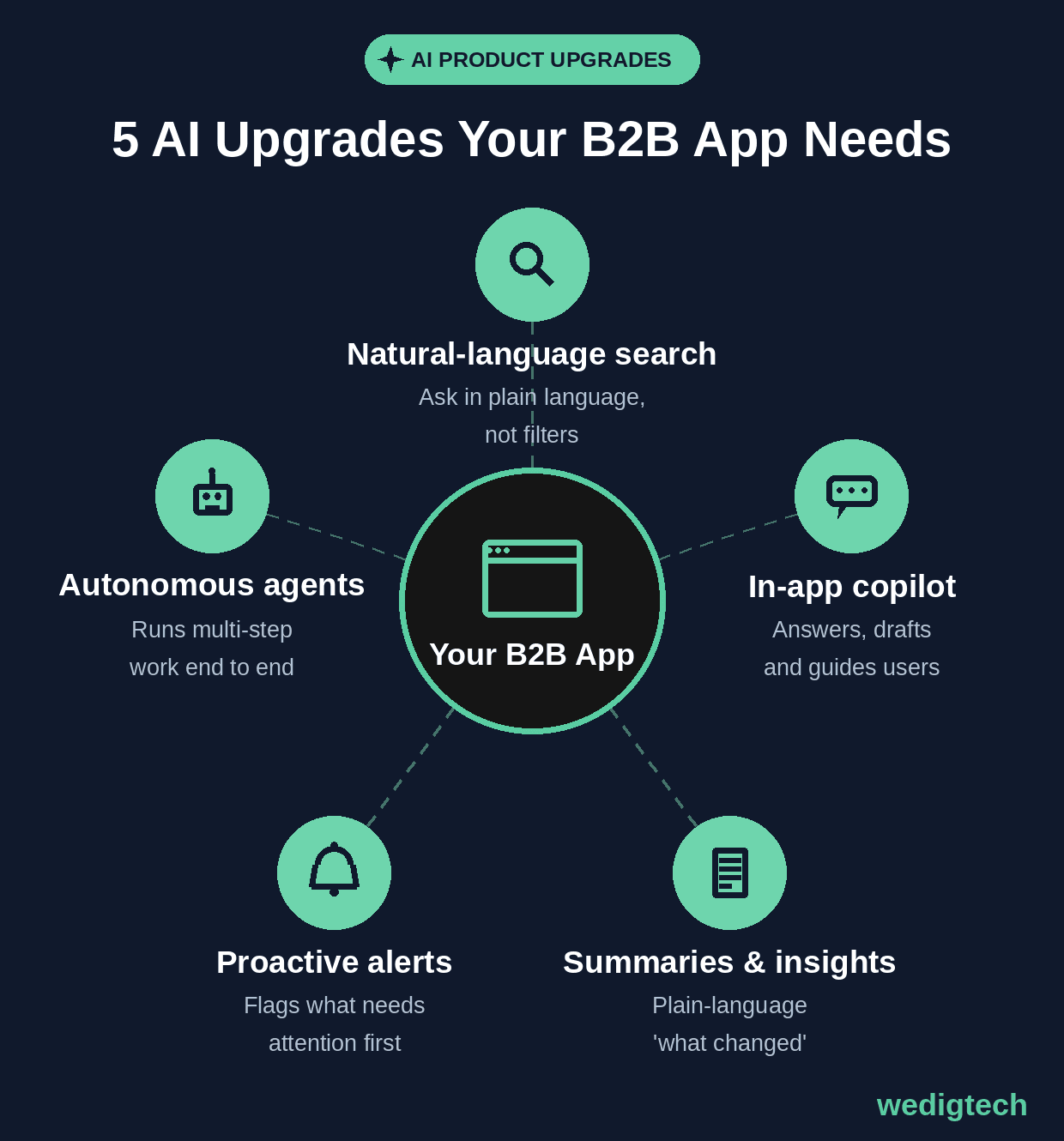
The five upgrades, ranked by what to ship first — low effort and high value at the top.
Which to Ship First
All five upgrades are worth building, so the real decision is sequence — and the ranking above makes it clear. Summaries and proactive alerts sit in the high-value, low-effort tier: they use data your app already has, they don't require a new interface, and they deliver a visible 'the product is smarter now' moment fast. Ship those first. Natural-language search is the next step up in effort and a strong second. The in-app copilot and autonomous agents are the biggest payoffs and the biggest builds — they're where premium pricing lives, but they're the destination, not the starting line.
Upgrade | The pain it removes | Ship priority |
|---|---|---|
Summaries & insights | Users drowning in raw data and dashboards | 1st — highest value, lowest effort |
Proactive alerts | Users find out about problems too late | 2nd — low effort, quick win |
Natural-language search | Users hunting through filters and menus | 3rd — high value, moderate effort |
In-app copilot | Users stuck on 'how do I do this?' | 4th — premium value, larger build |
Autonomous agents | Users doing repetitive multi-step work | 5th — highest value, most effort |
One caution that applies to all five: an AI feature buyers love can still lose money on every use, because each call has an inference cost. Price and scope each upgrade against that cost — the teams that win in 2026 tie the price of AI features to the value they create rather than giving them away and eroding margin, as multiple pricing analysts have noted. Shipping these well — reliably, on your data, without a full in-house AI team — is the kind of AI product work Wedigtech builds and runs with product teams; the five upgrades and the order are the same whether you build them in-house or with a partner.
What to Do This Week
Pick the one upgrade at the top of the list — AI summaries — and scope it for a single view. Choose the screen your users open most, write down exactly what a useful two-line summary of that screen would say, and confirm you can pass that screen's data to a hosted model to generate it. That's a shippable slice, not a project, and it's the fastest way to put a visibly smarter version of your product in front of users. Everything else on the list extends from the same pattern: your data, a hosted model, and one high-value moment at a time. If you'd find it useful to map these five against your own product and pricing — what to build, in what order, and how to keep the unit economics healthy — that's a short conversation worth having, and you can book a call to walk through it.
Was this helpful?
Ready to architect your next stage of growth?
Partner with wedigtech and turn ambition into compounding, measurable outcomes.
More from Insights
View All

Build AI Products and Operations Without Fronting the Cost: The Wedigtech Model
Most businesses fund 100% of their technology upfront and carry all the risk. Wedigtech's co-investment model is different: you invest ~30%, Wedigtech invests ~70%, and economics align to the value created.
Read More
The Best AI Tools to Automate B2B SaaS RevOps in 2026
The best AI tools to automate B2B SaaS RevOps in 2026 — the full stack by layer, from CRM and enrichment to forecasting and automation, with what AI does in each and where to start.
Read More
How to Find a Technology Partner for Your Mobile App Development in 2026
How to find a technology partner for mobile app development in 2026: the green flags to look for, the red flags to avoid, the exact process to shortlist and vet one, and the questions to ask.
Read More