Sep 30, 2026

The AI Features Every Modern Pharma App Should Have
The Real Problem a Pharma App Should Solve
Most pharma apps do very little. They show a product leaflet, maybe a basic reminder, and then sit unused on the patient's phone. Meanwhile, the single biggest problem in the industry goes unaddressed: roughly half of patients don't take their medication as prescribed. That non-adherence harms outcomes and costs healthcare systems hundreds of billions of dollars a year. It's also, for a pharma company, lost therapy value and a broken relationship with the patient.
AI changes what a pharma app can do about this. Instead of a static brochure, the app becomes an intelligent companion that keeps patients on therapy, answers their questions, watches for problems, and quietly generates real value for the business. This guide lays out the AI features worth building, what each one does for the patient and the business, and how to build them without falling foul of the rules that govern healthcare.
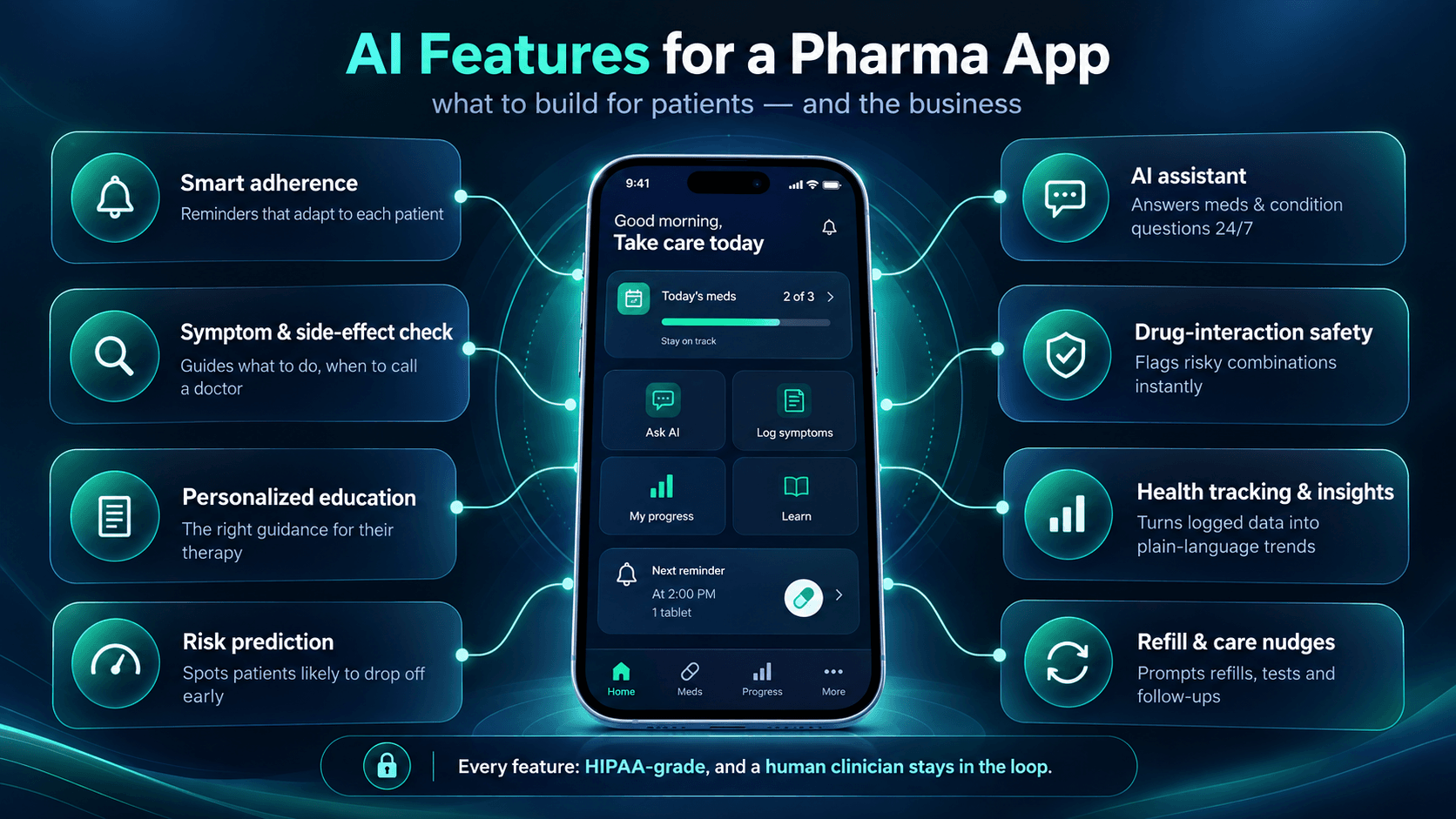
The core AI features a pharma company can build into its app.
The Patient-Facing AI Features
These are the features the patient sees and interacts with — the ones that keep them engaged and on therapy.
1. Smart medication adherence — The flagship feature. Instead of a fixed daily alarm, AI learns each patient's routine and adapts reminders to when they'll actually act — and escalates gently when doses are missed. This is where AI-driven personalization has been shown to move adherence, which is the metric that matters most.
2. An AI assistant (24/7) — A conversational assistant that answers the questions patients are often too rushed or embarrassed to ask a doctor: how to take the medication, what a side effect means, what to do if they miss a dose. Available any time, in plain language, grounded in approved information.
3. Symptom and side-effect checker — Patients worry most about side effects. An AI checker lets them describe what they're feeling and get guidance on whether it's expected, what to do, and — crucially — when to contact a doctor or seek urgent care. It also becomes a channel for pharmacovigilance (adverse-event reporting).
4. Drug-interaction safety checks — The app flags risky combinations — with other prescriptions, over-the-counter drugs, or food — before they cause harm. A high-trust safety feature that also protects the patient relationship.
5. Personalized patient education — Instead of a generic PDF, AI delivers the right guidance for the patient's specific therapy, stage, and concerns — bite-sized, timely, and in language they understand. Educated patients stay on therapy longer.
6. Health tracking with plain-language insights — Patients log symptoms, vitals, or doses; AI turns that raw data into a clear picture — 'your symptoms have improved since you started' — that motivates them and can be shared with their care team.
The Features That Create Business Value
These run quietly in the background, and they're what turn a patient app from a cost center into a strategic asset for the pharma company.
7. Risk prediction — AI analyzes engagement and adherence signals to spot patients likely to abandon therapy early — before they do — so a support program or clinician can intervene. This directly protects therapy revenue and improves outcomes.
8. Refill and care nudges — Timely, personalized prompts for refills, lab tests, and follow-up appointments keep patients on track and reduce the drop-off that happens between prescriptions.
Beyond these, the same app quietly generates value pharma companies pay a great deal for elsewhere: real-world data and evidence (anonymized, consented insight into how the therapy performs outside a trial), a direct patient relationship (rather than one mediated entirely by prescribers), and a channel for patient support programs and even trial recruitment. The AI features earn engagement; the engagement is what makes all of this possible.
AI feature | What it does for the patient | What it does for the business |
|---|---|---|
Smart adherence | Keeps them on therapy | Protects therapy value; better outcomes |
AI assistant | Answers questions 24/7 | Deflects support cost; builds trust |
Side-effect checker | Reassures and guides | Captures adverse events (pharmacovigilance) |
Drug-interaction checks | Prevents harm | High-trust safety; reduces liability |
Personalized education | Understands their therapy | Longer persistence on treatment |
Risk prediction | Gets timely support | Protects revenue; targets intervention |
Health insights + data | Sees their progress | Real-world evidence; direct relationship |
The Two Rules You Cannot Break
Healthcare is not like other apps, and two requirements are non-negotiable from day one. First, compliance and data protection: patient data is protected health information, so the app must be built HIPAA-grade (and GDPR-grade where relevant) — encrypted, consented, audit-logged, with AI vendors under the right agreements. Second, the human-in-the-loop rule: AI can inform, guide, and flag, but it must not diagnose or replace clinical judgment. Every clinical-adjacent feature needs clear boundaries, safe fallback ('contact your doctor'), and a clinician in the loop for anything consequential. Build these in from the start; they cannot be bolted on later.
What to Build First
You don't build all eight at once. Start where the impact and the evidence are clearest: smart adherence and the AI assistant. Adherence is the industry's core problem and the metric every stakeholder cares about; the assistant is the feature patients engage with daily and the one that makes the app feel alive. Ship those two well — genuinely personalized, genuinely helpful, fully compliant — prove the engagement and adherence lift on a real patient cohort, and use that evidence to justify the rest. One excellent, trusted feature beats eight half-built ones, especially in healthcare where trust is everything.
Building a Compliant AI Pharma App, Faster
Building these features well is a real undertaking — the AI has to be accurate on medical content, the whole thing has to be HIPAA-grade, and the clinical guardrails have to be right. That combination is exactly the kind of AI product work Wedigtech does: designing and building AI-powered products and platforms, with the compliance and clinical-safety requirements handled, and shipping them fast rather than over the year an in-house build from scratch would take. The features and priorities above are the same whether you build them in-house or with a partner.
If it would help to map these to your own product — which features to build first, how to keep them compliant, and what a fast build would look like — that's a short conversation worth having, and you can book a call to walk through it.
Was this helpful?
Ready to architect your next stage of growth?
Partner with wedigtech and turn ambition into compounding, measurable outcomes.
More from Insights
View All
How Smart Brands Use AI for Marketing in 2026 (Case Study + Playbook)
How new-age brands use AI for marketing — the six core plays, a deep case study of Spotify's AI marketing engine, the real learning for everyone else, and how to build it.
Read More
100+ AI Tools for B2B SaaS Founders (Organised by Use)
A categorised directory of 100+ AI tools for B2B SaaS founders — for content, SEO, sales, support, coding, automation, analytics and more — with what each one is best for.
Read More
Why Your B2B SaaS Gets Traffic But No Demo Bookings in 2026
Getting traffic but no demo bookings? The leak is rarely the traffic. Here's the B2B SaaS demo booking funnel, where it leaks, and how to fix each stage.
Read More