Oct 22, 2026
Your Second COO Is AI: How D2C Brands Run Operations on Autopilot
There's a job title you never gave yourself but hold anyway: Chief Operating Officer. You started your D2C brand for the product, the story, the customers. Yet most of your week disappears into operations — the stockout you noticed a day too late, the fulfilment exception sitting in an inbox, the support backlog, the Monday scramble to work out what last week's numbers actually mean. That's not founder work. That's COO work. And right now, you're the COO.
A COO is the person who makes the operation run so the founder can lead. Most growing D2C brands don't have one — hiring a real COO early is expensive and often premature — so the role doesn't disappear, it just lands on you. The result is a founder doing the highest-value and the most repetitive work in the same day, and rarely enough of the first.
What changed in 2026 is that AI moved from answering questions to running operations. It can now hold the operational layer of a brand — the watching, the flagging, the reporting, the chasing — which turns out to be most of what a COO does day to day. Set up well, it behaves less like a tool you open and more like a second COO that never sleeps. Here's what that actually looks like, what it can't do, and how to build it.
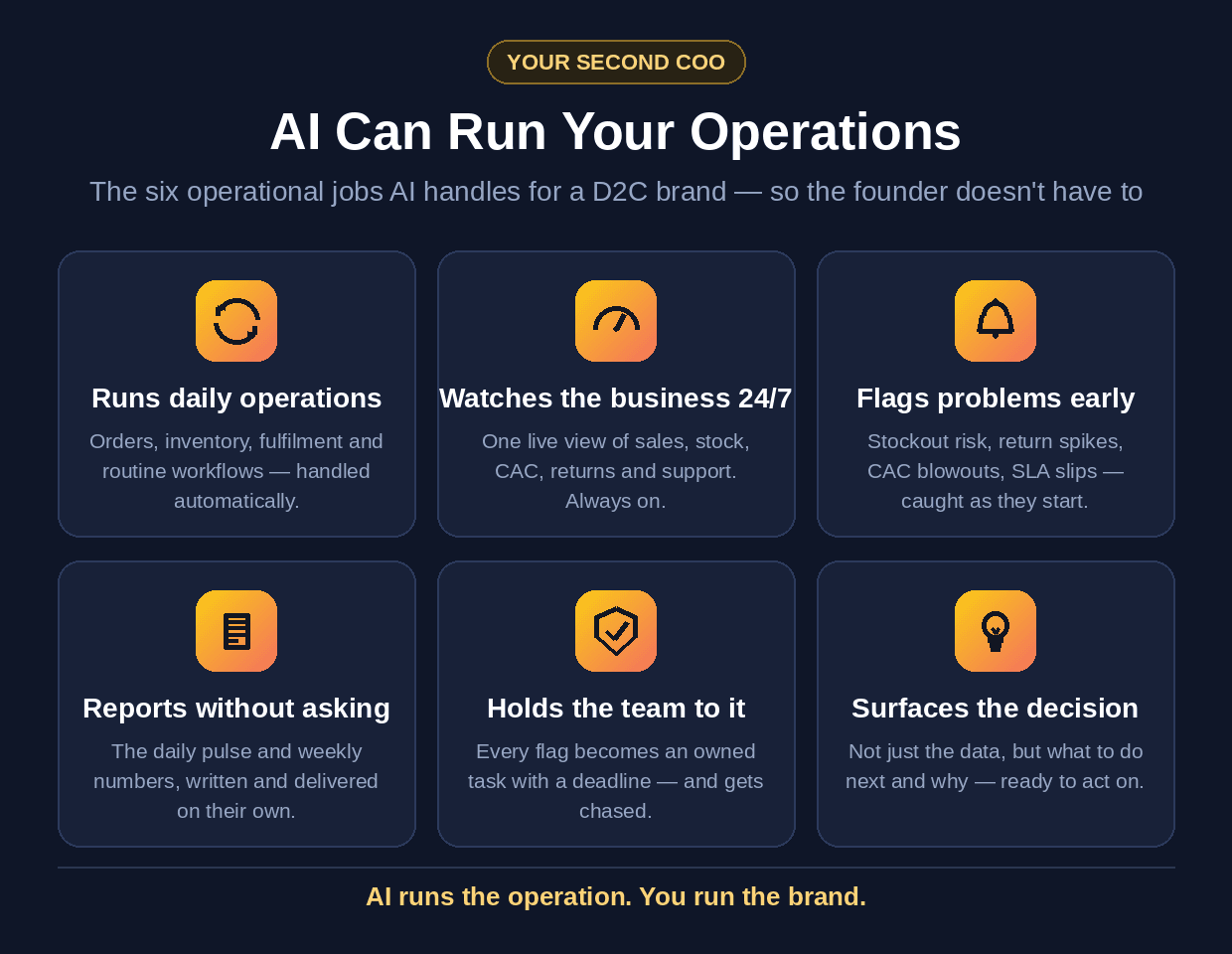
The six operational jobs an AI second COO runs for a D2C brand.
What a COO actually does (and why AI can do most of it)
Strip away the title and a COO does six things: keeps operations running, keeps full visibility across the business, catches problems early, reports and holds people accountable, turns data into decisions, and frees the founder to lead. Look closely and only a slice of that is pure judgment. The rest is relentless attention and coordination — checking every number, noticing what moved, chasing the loose end, writing the update. That relentless-attention layer is exactly what AI is now good at: it never gets tired, never forgets to check, and watches everything at once. So the honest split is simple — AI takes the attention and coordination; you keep the judgment.
The six operational jobs your AI second COO takes on
1. It runs the daily operations. Order sync, inventory updates, reorder triggers, fulfilment exceptions, the repetitive workflows that move a brand through a day — AI runs them on the rules you set. The routine stops needing a human to push it, and only the genuine exceptions reach you.
2. It watches the whole business, 24/7. Instead of tabbing between your store, the ad accounts, the 3PL dashboard and the helpdesk, AI pulls them into one live view — sales, stock, CAC, returns, delivery times, support backlog — and keeps watching long after you've closed the laptop. Nothing waits until Monday to be noticed.
3. It flags problems before they cost you. A COO's real value is catching the stockout, the return spike, or the CAC blowout before it becomes a lost week. AI watches every metric continuously and surfaces the anomaly the moment it appears — a SKU trending toward empty, returns climbing on one product, a channel's cost quietly doubling — while there's still time to act.
4. It reports without being asked. The daily pulse, the Monday numbers, the “what changed and why” — written and delivered on their own, in plain language, to your inbox or your team channel. No one spends Sunday night building a dashboard screenshot. The report just arrives.
5. It holds the operation accountable. A flag is only useful if someone acts on it. AI turns each one into an owned task with a deadline, nudges the owner, and closes the loop — so “we should reorder that” doesn't quietly become next week's stockout. This is the piece most automation skips, and it's the piece that makes it feel like an actual COO.
6. It surfaces the decision, not just the data. The leap that matters is from “returns are up 8%” to “returns on SKU-12 jumped 40% since the new supplier batch — switch back or investigate.” AI connects the signals and brings you the decision ready to make, so your time goes to choosing, not to assembling the context.
What stays human (your AI COO has a boss: you)
An AI second COO runs the how. You own the what and the why — the brand's taste and point of view, the big bets, the supplier and partner relationships, hiring and culture, and the calls that need context the system doesn't have. The goal isn't a brand with no humans in operations; it's humans freed from the operational grind to do the work only they can. And when you do grow into a real COO hire, this layer makes them stronger rather than redundant: they lead the operation instead of drowning in it, because the watching and chasing already runs itself.
How to build your AI second COO in four weeks
Week 1 — Connect the data. Bring your commerce platform, ad accounts, fulfilment/3PL, helpdesk and finance into one place. You can't run operations you can't see, and this is the foundation everything else sits on.
Week 2 — Turn on the watching layer. Stand up one live view and set alerts on the handful of metrics that actually move the brand — stock, CAC, returns, delivery SLA, support backlog. This alone replaces hours of manual checking.
Week 3 — Automate the top three workflows. Pick the three recurring operational tasks that eat the most time — usually reorder prompts, order/fulfilment exceptions, or support triage — and let AI run them end to end.
Week 4 — Close the loop. Add automatic reporting and turn flags into owned, chased tasks. Now the layer doesn't just notice and tell you — it makes sure things get done.
Then it compounds. Every new workflow you hand over makes the operation lighter, and the brand starts running on a layer that gets more capable each month instead of a founder who gets more stretched.
What to do this week
You don't need a platform decision to start — you need a list. Write down every operational task you personally touched this week, then mark the ones that are pure watching, chasing, or reporting rather than real judgment. That list is the job description for your AI second COO. Start with the single most time-consuming item on it, hand that one off well, and let the proof of a week back in your calendar pull you to the next.
The partner that builds and runs it
Setting up a tool is the easy part. Turning a pile of connected apps into an operations layer that genuinely runs the day-to-day — and keeps running as the brand grows — is the hard part, and it's where most brands stall. That's the work Wedigtech does: not another tool, but the intelligent-operations partner that designs, builds and runs the AI-led layer that acts as your second COO, across the systems you already use. (A D2C brand is the example here; the same operational layer works for any growing business.)
If you'd like to map which operational jobs AI could take off your plate first — and what a second COO would actually run in your business — that's a short conversation worth having.
Was this helpful?
Ready to architect your next stage of growth?
Partner with wedigtech and turn ambition into compounding, measurable outcomes.
More from Insights
View All

100+ AI Tools for Services Businesses (Organized by Use)
A categorised directory of 100+ AI tools for services businesses — for proposals, CRM, scheduling, delivery, support, finance, marketing and more — with what each one is best for.
Read More
Build AI Products and Operations Without Fronting the Cost: The Wedigtech Model
Most businesses fund 100% of their technology upfront and carry all the risk. Wedigtech's co-investment model is different: you invest ~30%, Wedigtech invests ~70%, and economics align to the value created.
Read More
The Best AI Tools to Automate B2B SaaS RevOps in 2026
The best AI tools to automate B2B SaaS RevOps in 2026 — the full stack by layer, from CRM and enrichment to forecasting and automation, with what AI does in each and where to start.
Read More