Oct 23, 2026

20 AI Agents for a Founder's Daily Department Reporting
By 9am, a founder should already know what moved overnight. Did a deal close or slip. Did cash dip below plan. Did an incident hit production. Is a big account suddenly unhappy. In most companies the founder finds out late, from the person who should have flagged it first, after the window to act has closed. Reporting is a quiet tax on a founder's attention, paid every single day in tabs, dashboards and status pings.
AI agents change who does the reporting. An AI reporting agent is a small, focused worker that connects to one department's tools, pulls that function's numbers on a schedule, writes the update in plain language, and flags anything that moved against yesterday or against target. It does not replace the team. It replaces the chasing. Below are 20 of them, grouped by the department they watch, and the one agent that ties them all together.
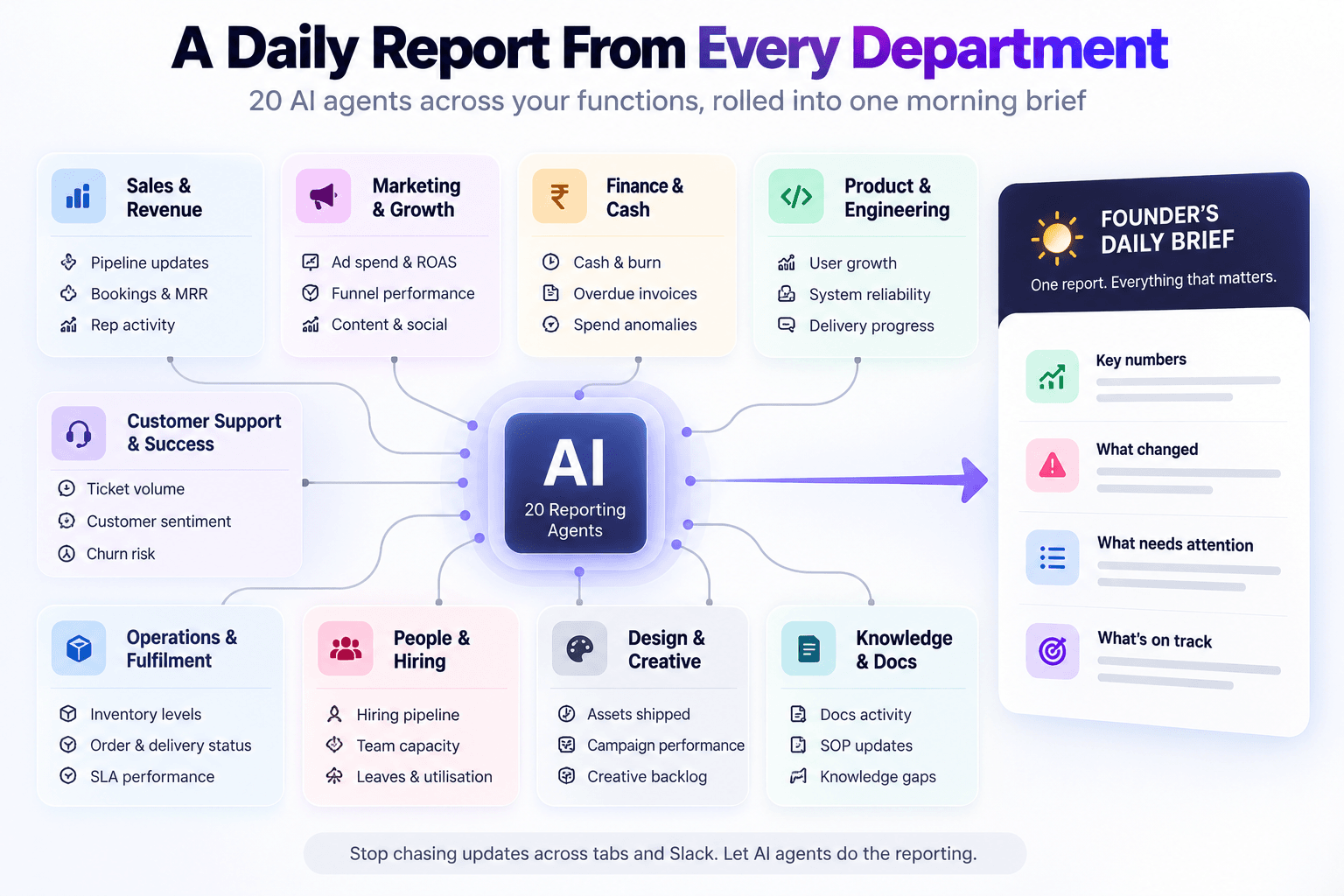
20 AI reporting agents across seven functions, rolled into one founder digest.
What a reporting agent actually does
Each agent does the same four jobs for its own department. It connects to the source of truth for that function, whether that is a CRM, the ad accounts, the ledger, product analytics or the helpdesk. It pulls the numbers that matter on a daily schedule. It writes them up in a sentence a human can read, not a raw dashboard. And it compares today to yesterday and to target, so it can flag the one number that broke pattern. The value is not another dashboard. It is that the report writes and checks itself.
Sales and Revenue
Agent | What it reports each day |
|---|---|
Pipeline Agent | New deals, stage moves, stalled deals, and forecast vs target |
Revenue Agent | Yesterday's bookings and MRR, run rate, and change vs plan |
Rep Activity Agent | Calls, demos and follow-ups per rep, and who has gone quiet |
Marketing and Growth
Agent | What it reports each day |
|---|---|
Spend and ROAS Agent | Ad spend, CAC and ROAS by channel, with cost spikes flagged |
Funnel Agent | Traffic, signups and conversion rates through the funnel |
Content and Social Agent | Posts shipped, reach, and the top performing content |
Finance and Cash
Agent | What it reports each day |
|---|---|
Cash and Burn Agent | Cash balance, daily burn, and months of runway left |
Collections Agent | Overdue invoices, who to chase, and cash expected this week |
Spend Anomaly Agent | Unusual charges, subscription creep, and budget overruns |
Product and Engineering
Agent | What it reports each day |
|---|---|
Usage Agent | Active users, activation rate, and feature adoption |
Reliability Agent | Incidents, error rates and uptime since yesterday |
Delivery Agent | Sprint progress, work merged, and what is blocked |
Customer Support and Success
Agent | What it reports each day |
|---|---|
Ticket Agent | New vs resolved tickets, backlog, and SLA breaches |
Sentiment Agent | CSAT, review trends, and recurring complaints |
Churn-Risk Agent | Accounts showing warning signs and renewals due this week |
Operations and Fulfilment
Agent | What it reports each day |
|---|---|
Inventory Agent | Stock levels, reorder alerts, and stockout risk |
Fulfilment Agent | Orders shipped, delays, and delivery SLA |
People and Hiring
Agent | What it reports each day |
|---|---|
Hiring Agent | Pipeline by role, interviews scheduled, and offers out |
Capacity Agent | Team utilisation, leave, and overloaded functions |
20. The agent that turns the other nineteen into one brief
Nineteen daily reports is not progress. It is nineteen new tabs. The twentieth agent is the one that matters most: a digest agent that reads every other agent's output, drops what is normal, and surfaces only what changed and what needs a decision. Instead of twenty updates, the founder gets one short brief each morning that says, in effect, here is what is on track, here are the three things that moved, and here is the one that needs you today.
Agent | What it reports each day |
|---|---|
Daily Digest Agent | Reads all nineteen agents, drops the normal, and surfaces only what changed and what needs a decision |
How to start without drowning in agents
Do not switch on twenty agents at once. Pick your three blind spots: the functions where you consistently find out too late, which for most founders are cash, pipeline and customer health. Stand up those three agents first, get them trustworthy, and let the quiet of not chasing those updates prove the model. Then add the next three. Within a quarter you can have the full set feeding a single brief, built up at a pace where you actually trust each agent's numbers.
What stays the founder's job
Agents report and flag. They do not decide. The judgment calls, which deal to personally save, whether a cash dip is a blip or a trend, when a churn risk is worth a founder's call, stay yours. What the agents remove is the part that was never a good use of a founder's day: the collecting, formatting and chasing that stood between you and the decision. You get to the decision faster, with the context already assembled, rather than spending the morning assembling it.
From twenty agents to one intelligent operation
Wiring an agent to a single tool is easy. Connecting all twenty to your real systems, keeping their numbers accurate, and making the morning brief something a founder genuinely trusts is the hard part, and it is where most of these efforts stall. That is the work Wedigtech does: not another tool, but the partner that designs, builds and runs the AI-led operations layer that reports your business to you, so your attention goes to decisions instead of status.
If you want to map where you find out too late today, and which reporting agents would close those gaps first, that is a short conversation worth having.
Was this helpful?
Ready to architect your next stage of growth?
Partner with wedigtech and turn ambition into compounding, measurable outcomes.
More from Insights
View All
Your Second COO Is AI: How D2C Brands Run Operations on Autopilot
Every D2C founder is secretly the COO — running inventory, support, fulfilment and reporting in the gaps. Here's how AI becomes your second COO: watching the business 24/7, flagging problems early, and running the operational busywork.
Read More
100+ AI Tools for Services Businesses (Organized by Use)
A categorised directory of 100+ AI tools for services businesses — for proposals, CRM, scheduling, delivery, support, finance, marketing and more — with what each one is best for.
Read More
Build AI Products and Operations Without Fronting the Cost: The Wedigtech Model
Most businesses fund 100% of their technology upfront and carry all the risk. Wedigtech's co-investment model is different: you invest ~30%, Wedigtech invests ~70%, and economics align to the value created.
Read More