Aug 25, 2026

The 90-Day AI Capability Roadmap for a Growing D2C Brand
The Problem Is Rarely the Tools. It's the Order You Build In.
Most growing D2C brands do not fail at AI because they picked the wrong tool. They fail because they start in the wrong place — bolting an AI chatbot onto an operation with no documented processes, or generating content before anyone has written a brand-voice guide, or buying six disconnected tools that never talk to each other. The tools work. The sequence doesn't.
This is an implementation problem, and it has an implementation answer: a clear order to build in. What follows is a 90-day roadmap for putting AI to work across a D2C brand — three phases, each with the exact capabilities to implement and the specific actions to take. It is not a lesson in why AI matters. It is the build plan.
The reason to move on a defined timeline is that the returns arrive fast once the sequence is right. Across 23 US D2C implementations, brands saw first revenue-visible wins within the first 30 days, and 19-27% conversion increases alongside 40-60% lower support costs within 90 days, according to Braincuber (2026). The 90-day window is realistic — the discipline is doing the phases in order.
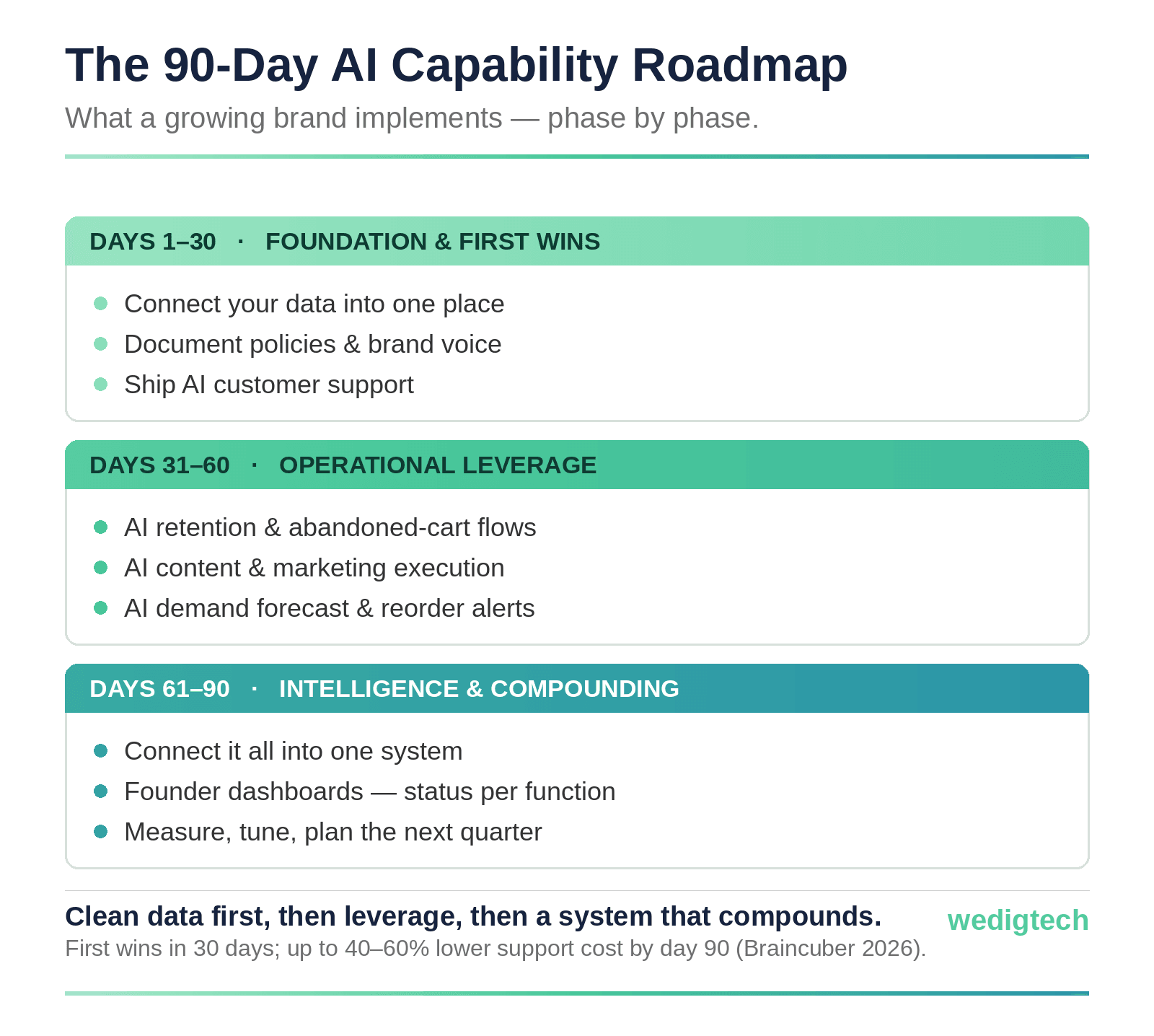
The three phases — foundation, leverage, and a connected system that compounds.
The Prerequisite Most Brands Skip
Before Phase 1, one rule governs the whole roadmap: an AI agent can only execute a process that actually exists. As AISmith (2026) puts it plainly, you cannot automate a process you have not defined — if your customer service runs on tribal knowledge, your AI support will fail, because it has no documented protocol for the edge cases, and if you have not written a brand-voice guide, AI-written emails will sound like a generic corporate robot. This is why 'document your policies and brand voice' sits inside Phase 1, not as an afterthought. Defining the process is the first act of implementing the AI, not a step you skip to get to the fun part.
Phase 1 — Days 1-30: Foundation & First Wins
The goal of the first month is a clean foundation and one live capability that saves time immediately. Three actions:
1. Connect your data into one place. Consolidate orders, customers, support history, and marketing engagement into one source, keyed to the customer. Clean, connected data is the prerequisite for everything that follows — as Elogic (2026) notes, product and customer data quality comes first because it is what every AI capability runs on.
2. Document your policies and brand voice. Write the support protocols (including the edge cases — the lost package, the late return, the VIP exception) and a one-page brand-voice guide. This is what makes the next step work.
3. Ship AI customer support. Deploy an AI agent to handle the high-volume, repetitive queries — order status, returns, FAQs (on WhatsApp too, if that's where your customers are). It is the fastest ROI in the roadmap and the source of the first 30-day win, cutting support cost while keeping response times low.
Phase 2 — Days 31-60: Operational Leverage
With the foundation in place, month two puts AI to work across the high-volume operational functions. Three capabilities:
1. AI retention and abandoned-cart flows. Move from generic, one-size-fits-all sequences to AI-driven ones — post-purchase and replenishment flows, plus smarter cart recovery that reads the behavioural signal behind the abandonment. AI-driven proactive recovery converts materially better than fixed sequences (Rep AI data cited by Adeeshi, 2026).
2. AI content and marketing execution. Put AI on the volume work: product descriptions, email segmentation, and ad and video creative variants. This is where a small team stops being the bottleneck on how much the brand can ship.
3. AI demand forecasting and reorder alerts. Implement demand forecasting that flags stockouts and reorder points, and dynamic pricing within guardrails you set. This turns inventory work that used to need a hire into alerts a founder approves.
Phase 3 — Days 61-90: Intelligence & Compounding
The final phase is what separates a pile of AI tools from an intelligent operation. Three actions:
1. Connect the capabilities into one system. Make the data flow between them — so a support interaction informs retention, and purchase behaviour informs recommendations. Connection is where the compounding comes from; disconnected tools stay stuck at the sum of their parts.
2. Add founder dashboards. Build the dashboards that surface quick status on every function — so you stop chasing updates and see the whole brand in minutes. Visibility is the capability that gives the founder their time back.
3. Measure, tune, and plan the next quarter. Track the numbers that matter — conversion, support cost, retention, hours reclaimed — tune what underperforms, and set the roadmap for the next 90 days. By now the day-90 outcomes (higher conversion, sharply lower support cost) should be visible in the data.
Phase | Build | The exact first action |
|---|---|---|
Days 1-30 | Data + processes + AI support | Consolidate data to one source; write support protocols + brand voice |
Days 31-60 | Retention, content, forecasting | Ship one AI retention flow; put AI on product copy + email |
Days 61-90 | Connect, dashboards, measure | Wire the tools into one data flow; build the founder dashboard |
What to Do This Week
You do not need the whole 90 days planned to start. Do these three things now. First, list every place your customer and order data currently lives, and pick the one place it will all flow into — that decision unblocks the entire roadmap. Second, open a doc and write your ten most common support scenarios and exactly how each should be handled, including the awkward edge cases; that document is what your AI support will run on. Third, write your one-page brand-voice guide. Those three artifacts are Phase 1's foundation, they cost nothing but a few hours, and nothing else can be implemented well until they exist.
The whole roadmap rewards the same discipline: build in order, define before you automate, and connect before you expect compounding. A brand that does the phases in sequence has a working AI operation in 90 days; a brand that skips to the visible parts usually spends 90 days undoing them.
Where Wedigtech Comes In
Running this roadmap well is an AI-led operations problem, and it is what Wedigtech does. Wedigtech does not sell a course on D2C or hand over a list of tools — it builds and runs the intelligent operations. That means doing the roadmap with you: connecting the data foundation, defining the processes, building the AI capabilities as agents across each function, wiring them into one system, and standing up the dashboards that keep you informed. The result is a working AI operation by day 90, not a backlog of tools you now have to integrate yourself.
Keep going: to go deeper on the first phase, read “What should a D2C brand automate first with AI?” and “Creating AI SOPs that every department can follow.” And if you'd rather have the 90-day roadmap built and run with you than staff it yourself, book a call and we'll map it to your brand.
Was this helpful?
Ready to architect your next stage of growth?
Partner with wedigtech and turn ambition into compounding, measurable outcomes.
More from Insights
View All

How to Find a Technology Partner for Your Mobile App Development in 2026
How to find a technology partner for mobile app development in 2026: the green flags to look for, the red flags to avoid, the exact process to shortlist and vet one, and the questions to ask.
Read More
How to Prioritize AI Features for Your SaaS Product (2026 Roadmap)
An AI product roadmap for SaaS: exactly which AI features to build first, which to build next, and which to skip — plus the one test that tells you where any AI feature belongs.
Read More
How Smart Brands Use AI for Marketing in 2026 (Case Study + Playbook)
How new-age brands use AI for marketing — the six core plays, a deep case study of Spotify's AI marketing engine, the real learning for everyone else, and how to build it.
Read More