Oct 28, 2026

How to Automate a Services Business With AI in 2026
A services business sells time. An agency, a consultancy, a studio, a professional-services firm: the product is your people's hours, which means every hour lost to admin is margin that never reaches the bottom line. Chasing leads, writing proposals, onboarding clients, updating status, raising invoices and building reports are all necessary, and none of them are the work the client pays for. They are the tax a services business pays on doing business.
That tax is exactly what AI now removes. In 2026 the shift is that AI does not just help with the admin, it runs it, as automated workflows that need a person only for the judgment calls. Because the work of a services business is repeatable and follows a clear client lifecycle, it is one of the easiest kinds of business to automate well. Here is where to automate, in what order, and what to keep human.
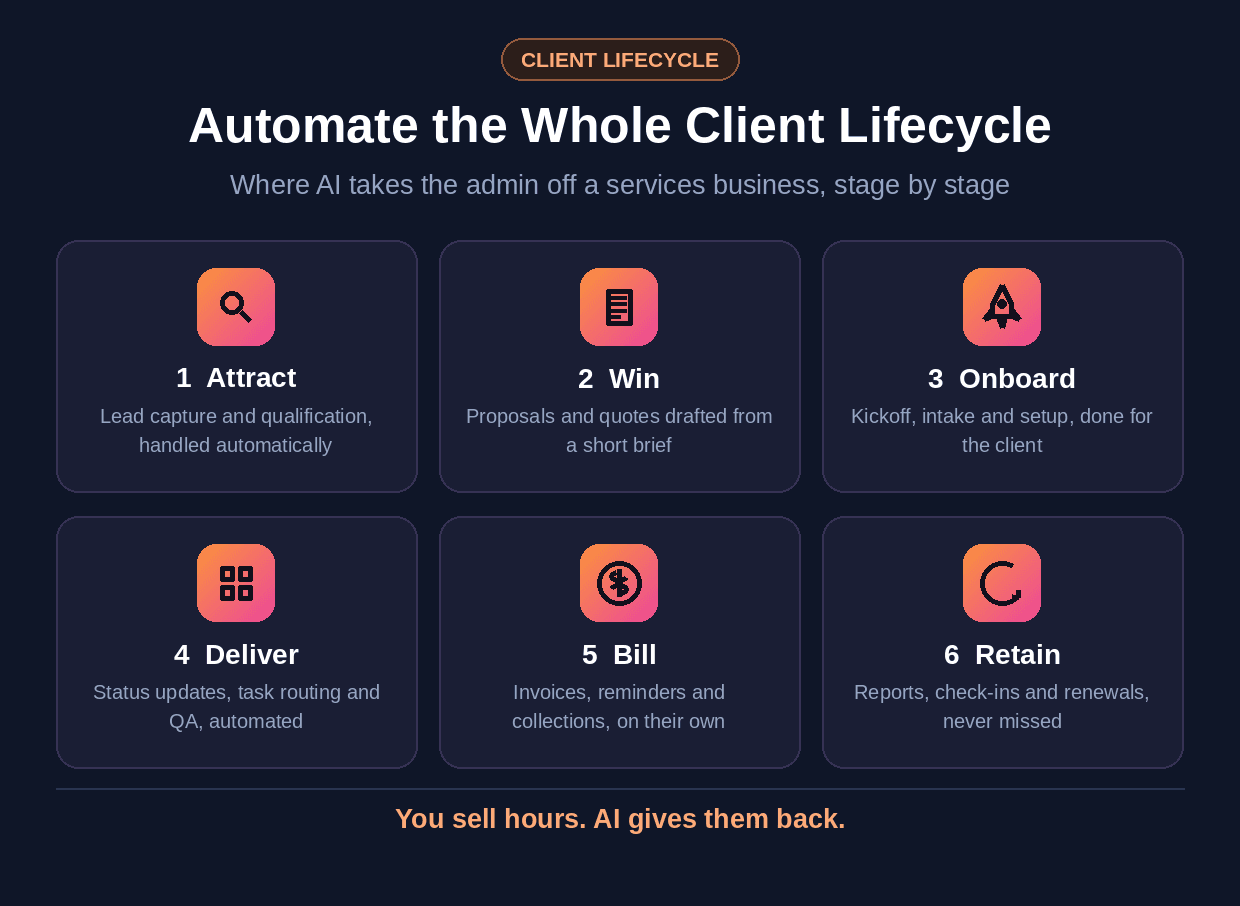
The six stages of a services business, and where AI takes the admin off each one.
Why a services business is the best kind to automate
Two things make a services business unusually easy to automate. First, the work repeats: nearly every client moves through the same lifecycle, from first enquiry to delivery to renewal, so the same tasks recur with every engagement. Second, margin is tied directly to hours, so any admin hour you move off a person converts straight into either capacity or profit. A product business has to automate to scale units. A services business automates to stop selling its margin back in overheads, which is a faster and more direct win.
The six places to automate across the client lifecycle
1. Attract: automate lead capture and qualification. The manual work here is catching every enquiry, enriching it, and deciding who is worth a call. AI can capture each inbound lead, enrich it with company and contact data, qualify it against your ideal-client criteria, and route only the strong fits to a human while the rest are nurtured automatically. No lead sits unanswered, and your time goes to real prospects instead of triage.
2. Win: automate proposals and quoting. Most firms lose hours writing bespoke proposals and quotes from a blank page. AI can turn a short brief or a discovery-call transcript into a tailored proposal, scope and price, built from your own templates and past deals. Proposals go out in minutes while the deal is still warm, not days later when the prospect has cooled.
3. Onboard: automate client onboarding. The kickoff is usually a scramble of intake forms, access, contracts and setup. AI can run the onboarding sequence the moment a client signs: collect intake, chase missing information, set up the workspace, and brief the delivery team. The client feels momentum from day one instead of a slow, disorganised start.
4. Deliver: automate project updates and delivery admin. Status updates, task routing, QA checks and the constant where-are-we questions eat into delivery time. AI can pull progress from your project tools, write client-ready status updates, route tasks to the right owner, and flag what is slipping before it becomes a fire. Delivery stays on track and clients stay informed without anyone writing an update by hand.
5. Bill: automate invoicing and collections. Raising invoices, sending reminders and chasing late payers is pure admin that quietly leaks revenue. AI can generate invoices from delivered work or milestones, send them on schedule, follow up on overdue ones, and flag the cash coming in. You get paid faster and stop losing money to invoices nobody remembered to chase.
6. Retain: automate reporting, check-ins and renewals. Recurring client reports, check-ins that slip, and renewals that get missed are where repeat revenue leaks. AI can generate each client's report from the live numbers, prompt check-ins at the right moment, and flag renewals and upsell signals before they lapse. Accounts get looked after on a schedule, which is exactly where repeat revenue lives.
How to actually automate it, not all at once
Map your workflows and find the time sinks. Write down every repeatable task across the lifecycle above and mark the ones that are high volume and highly manual. That list is your automation backlog, in priority order.
Start with highest volume times most manual. Pick the single task that eats the most hours for the least judgment, usually proposals, status updates or invoicing, and automate that one first. One clear win builds the case for the rest.
Automate end to end, not half. A workflow that is mostly automated but still needs a person to finish it saves almost nothing. Take one workflow all the way to done before you start the next.
Connect the pieces into one system. The real leverage is not any single automation, it is the handoffs: a signed proposal that creates the project, that feeds the invoice, that writes the client update. Wire the stages together so work flows between them on its own.
Keep humans on judgment and relationships. Automate the busywork, not the client relationship or the creative and strategic calls. Those are what clients pay a premium for, and the reason the automation is worth doing at all.
Measure capacity, not activity
Judge the automation by whether it frees capacity, not by how many tools you switched on. Track billable hours as a share of total hours, admin hours saved per week, margin per project, and revenue per head. If admin hours fall while margin and capacity per head rise, the automation is working. If you have added tools but your team is just as buried in admin, the workflows are half-built and need connecting, not replacing.
What stays human
AI takes the repetitive work off a services business. It does not take the relationship. The trust a client places in your judgment, the creative and strategic decisions, the hard conversations and the senior call on a tricky engagement all stay with your people. The point of automating the admin is to give your team more of their hours back for exactly that work, so the business grows on the strength of its expertise rather than stalling under its own overhead.
From scattered automations to one intelligent operation
Automating a single task is easy. Connecting the whole lifecycle so a signed proposal flows into onboarding, delivery, billing and reporting without anyone stitching it together is the hard part, and it is where most services businesses stall. That is the work Wedigtech does: not another tool, but the partner that designs, builds and runs the AI-led operations layer that takes the admin off your team, so your firm scales on expertise instead of headcount.
If you want to find where your firm is losing the most hours to admin, and which part of the lifecycle to automate first, that is a short conversation worth having.
Was this helpful?
Ready to architect your next stage of growth?
Partner with wedigtech and turn ambition into compounding, measurable outcomes.
More from Insights
View All

AI Onboarding Workflows That Cut Time-to-Value for SaaS
Seven AI onboarding workflows that cut time-to-value for SaaS: personalized paths, auto-import, a done-for-you first result, in-app copilots and behaviour-based nudges that turn sign-ups into activated users.
Read More
20 AI Agents for a Founder's Daily Department Reporting
20 AI agents that report a founder's daily numbers from every department: sales, marketing, finance, product, support, operations and people, rolled into one morning brief.
Read More
Your Second COO Is AI: How D2C Brands Run Operations on Autopilot
Every D2C founder is secretly the COO — running inventory, support, fulfilment and reporting in the gaps. Here's how AI becomes your second COO: watching the business 24/7, flagging problems early, and running the operational busywork.
Read More