Aug 25, 2026

How D2C Brands Are Winning With AI Team Roles in 2026
The Winning Brands Didn't Build an AI Team
There is a common assumption that the D2C brands pulling ahead in 2026 hired an AI team, or bought an all-in-one AI platform, or replaced their people with agents. None of that is what actually happened.
The brands winning this year did something quieter and more structural. As Sprints & Sneakers' 2026 D2C growth analysis puts it, AI is now embedded into every role, not separated into its own team. Growth analyst agents monitor funnels. Competitive intelligence agents track rivals. Paid media co-pilots surface optimisations. Creative intelligence agents identify which elements drive performance. Humans own strategy and creative judgment. The org chart did not gain an 'AI department.' Every existing role gained an AI layer.
That distinction is the whole game. The brands that treated AI as a separate initiative got a pile of disconnected tools. The brands that embedded an AI role into each function got compounding leverage — and it shows up directly in their numbers.
What Winning Actually Looks Like in the Data
The gap between brands running AI roles and brands watching from the sidelines is now measurable. By March 2026, AI-referred traffic converted 42% better than non-AI traffic, and retailers running their own shopper agents grew sales 59% faster than those on the sidelines, according to Salesforce data reported by eCorpIT (2026). AI-referred shoppers browse 13% more pages, spend 48% longer on site, and generate 37% more revenue per visit.
On the acquisition side, teams running AI-assisted creative at volume report customer acquisition cost falling 15 to 30%, roughly 22% higher return on ad spend, and an 18 to 34% lift in click-through versus fatigued creative, according to The DTC Playbook (2026). On retention — where profit actually lives — a 5% improvement can lift profit by 25 to 95%, and acquiring a new customer still costs 5 to 25 times more than keeping one (Sprints & Sneakers 2026).
These are not the results of buying a tool. They are the results of embedding an AI role into the function that owns each of those numbers, and freeing the human in that seat to work on judgment instead of execution.
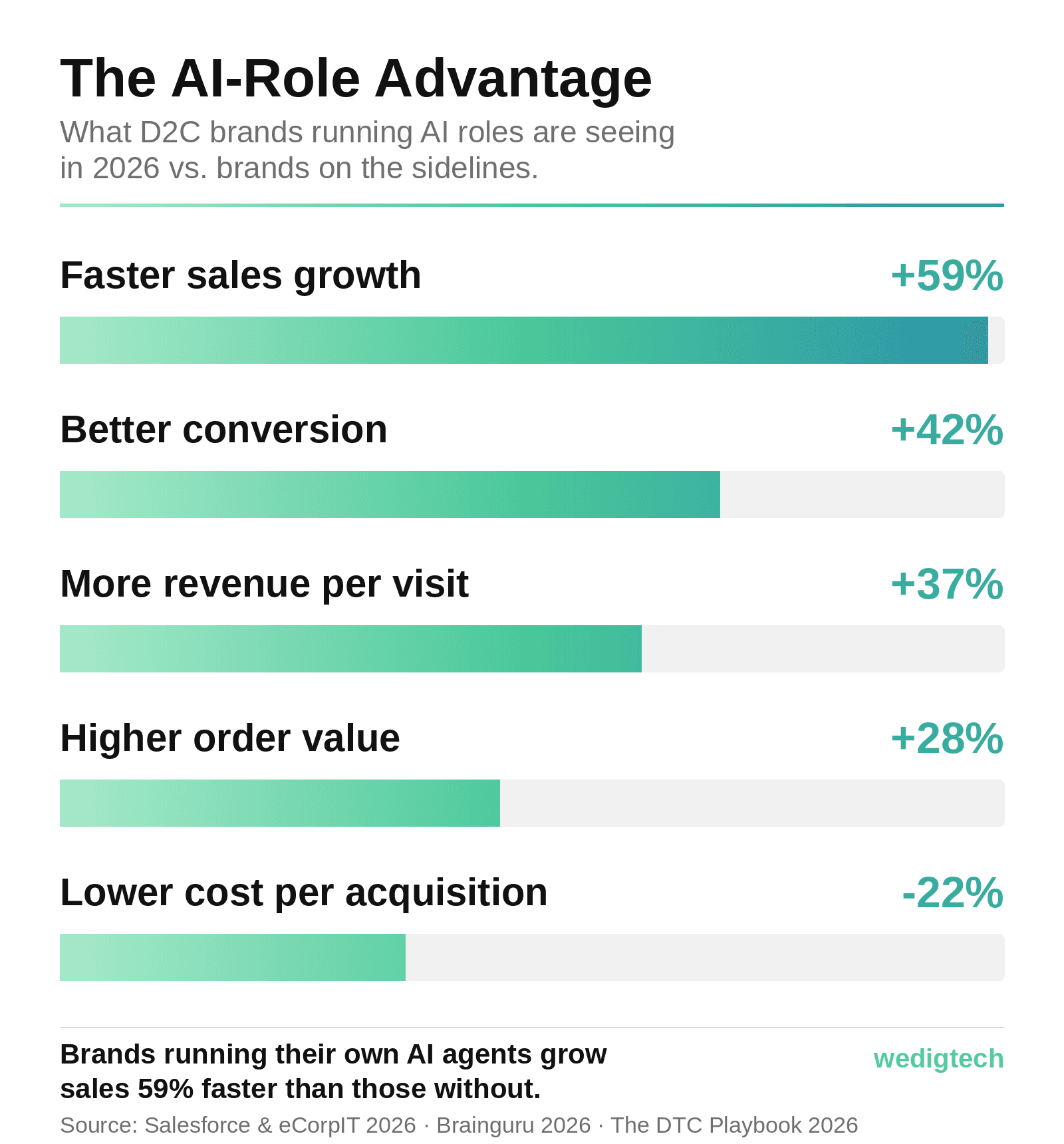
The AI-role advantage in 2026 — winning brands vs. those on the sidelines.
The AI Role Embed Map
Here is the map the winning brands are effectively running. For each core D2C function, it shows the AI role embedded into it, the judgment the human still owns, and the specific win that role drives. This is the difference between an AI team bolted on the side and AI embedded where the work already happens.
Read the third column carefully, because it is the one most people miss. In every winning setup, the human does not disappear. They move up the value chain — out of execution and into judgment, taste, and strategy. The AI role handles the volume. The human owns the calls that require context a model does not have.
Why Embedding Beats a Separate AI Team
The brands that stood up a separate AI function, or handed everything to one all-in-one platform, consistently underperform the brands that embedded roles. The reason is structural, and it is worth understanding before copying anyone's stack.
A separate AI team creates a translation layer between the people who understand the function and the people running the AI. An embedded AI role removes that layer. The insight from Pragmatic's 2026 analysis of AI marketing case studies is consistent across every example: the specific tool matters less than the workflow built around it. The highest measurable impact came from pairing AI generation with structured source material, documented brand voice, defined review gates, and a named human owner for quality. Teams that added AI to an already-clear workflow saw double-digit gains. Teams that added AI without that structure mainly saw more drafts to rewrite.
That is the failure mode of the separate-AI-team approach. It optimises the tool and neglects the workflow. Embedding an AI role into an existing function does the opposite — it starts from the workflow that already works and adds capacity where the human was the bottleneck.
What Winning Looks Like in Practice
Adore Me, a D2C intimates brand, gives a clean example of the embedded model working at scale. The brand used AI agents trained on product data and style guidance to support product descriptions, stylist notes, and marketplace content — but kept merchandisers, stylists, and native speakers in the workflow to refine outputs before publication, according to Pragmatic (2026). The AI was not treated as finished work. It was treated as a faster first pass inside a controlled production system with a named human owner at the quality gate.
That is the entire pattern in one sentence: the AI role produces the volume, the human owns the judgment, and the workflow connects them. The brands winning in 2026 are not the ones with the most AI. They are the ones who embedded it in the right place, with the right human still in charge of the decision that matters.
From Embedded Roles to a Connected System
Embedding an AI role into each function is the winning move. The next level — the one that separates the brands growing 59% faster from the brands growing merely faster — is connecting those roles into a single system. When the intelligence agent feeds the growth co-pilot's budget decisions, when the retention agent's signals trigger the right lifecycle flows, when the demand forecast informs the creative calendar, the roles stop being five separate wins and start compounding into one.
That connection is what Wedigtech's Technology System and Operating System are built to design and install for growth-stage D2C brands — mapping the right AI role into each function, building the data layer that lets those roles talk to each other, and installing the human oversight model that keeps quality high as volume grows. Because Wedigtech takes equity in the outcome, the system is built to keep compounding after Month 6 — an operating model that gets sharper as it runs, not one that stalls the moment the engagement ends.
Was this helpful?
Ready to architect your next stage of growth?
Partner with wedigtech and turn ambition into compounding, measurable outcomes.
More from Insights
View All

The Best AI Hiring Platforms in 2026 (and How to Actually Pick One)
A practical guide to the top AI hiring platforms in 2026 — the best tools for sourcing, screening, assessment and interviewing, the end-to-end vs best-of-breed decision, and how to choose and implement the right one.
Read More
The Founder's Figma Playbook: Design and Test Your Product Before You Build
A practical playbook for how founders use Figma to design great products: the exact workflow, how to use Figma Make and Dev Mode, and how to test your product before you write a line of code.
Read More
ClickUp Brain AI for Founders: 10 Use Cases, the AI Notetaker, and Why It Replaces Your Whole Stack
How ClickUp Brain AI helps founders and enterprises: the project-visibility problem it solves, 10 real use cases of Brain AI, exactly how to use the AI Notetaker, and why ClickUp replaces multiple tools.
Read More