Sep 17, 2026

The Best AI Hiring Platforms in 2026 (and How to Actually Pick One)
Screening and scheduling alone can swallow days of recruiter time on every single hire. That's the reason the AI hiring market has exploded — dozens of platforms now promise to hand that time back. The problem is that the market is also flooded with tools that slap 'AI' on a basic keyword filter, and the labels ('AI-powered,' 'talent intelligence,' 'agentic') blur together until every product sounds identical. This guide cuts through that: where AI actually helps in hiring, the platforms genuinely worth knowing, and how to choose and implement one that fits your team rather than the other way around.
First, a Map: Where AI Actually Helps in Hiring
Before comparing any tools, it helps to see the hiring funnel and where AI plugs into each stage — because most tools are built to win one part of it, and knowing which part you need is half the decision.
AI shows up at every stage of hiring — most tools specialise in one; a few span all of it.
At the top, sourcing tools find and reach candidates. Then screening tools parse and rank applications, or hold a conversation to qualify people at volume. Assessment tools test skills and predict fit. Interview tools run or transcribe the conversations. And coordination tools handle scheduling and keep candidates warm. The pattern that matters: voice and conversational AI screening can cut recruiter phone time by 60–80% and process three to five times more candidates a week, while matching and analytics platforms can reduce bad hires by 15–22%. The gains are real — but they land in different parts of the funnel.
The Decision You Have to Make Before You Look at a Single Tool
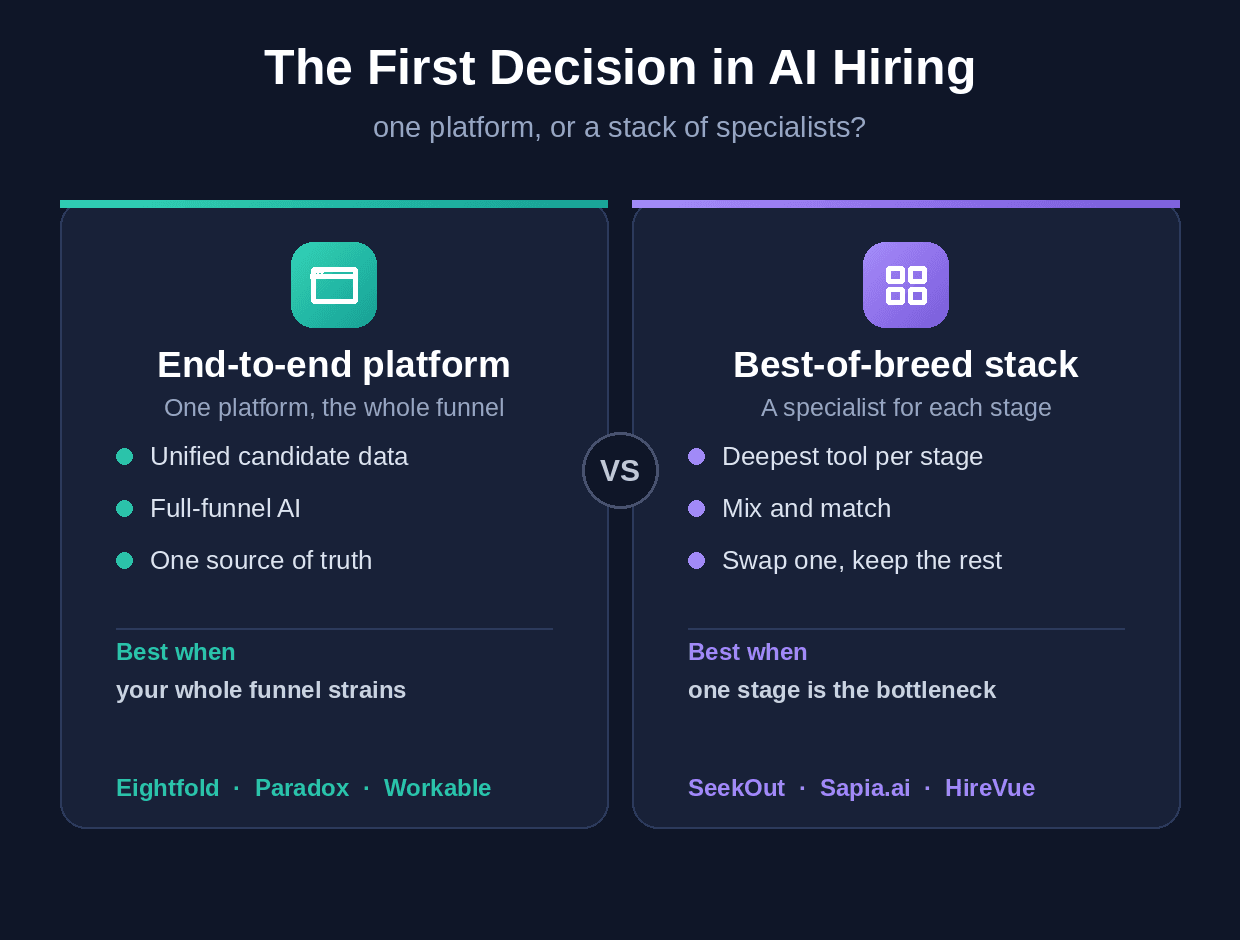
Here's the most useful thing in this entire guide, and it's the mistake most teams make: the first decision is architectural, not feature-led. You are choosing between an end-to-end AI recruiting platform that unifies the whole funnel, or a stack of best-of-breed specialists that each go deep on one stage. Get this wrong and every feature comparison that follows is measuring the wrong thing.
End-to-end platforms give you unified candidate data and full-funnel AI in one place — the right default if your team runs the whole funnel and values one source of truth. Best-of-breed specialists give you depth in one stage — the right call when a single stage (usually sourcing or high-volume screening) is your dominant bottleneck, or when you just need to replace one weak tool in an otherwise working stack. Decide this first. Then the shortlist below almost picks itself.
The Top AI Hiring Platforms, by What They're Best At
Here are the platforms genuinely worth your shortlist in 2026, grouped by where they win.
End-to-end platforms (the whole funnel)
Eightfold AI leads on talent intelligence — a deep skills graph matching across a vast profile base, now with an AI interviewer. Paradox (Olivia) owns high-volume, hourly hiring with conversational AI that screens and schedules at scale, which is why the largest hourly employers use it. Phenom and Beamery bring full talent-experience and CRM-led platforms. And Workable is the strongest AI-native ATS for mid-market teams wanting sourcing, screening, and an applicant tracking system in one.
Sourcing specialists (find and reach candidates)
Juicebox lets you search 800M+ profiles in natural language without writing Boolean strings. SeekOut and hireEZ are the deep-search specialists for passive candidates, with outreach sequencing. Findem adds attribute-based talent search. If your bottleneck is finding people, this is your row.
Screening specialists (qualify at volume)
HeyMilo runs agentic voice and video screening interviews autonomously. Sapia.ai does bias-controlled, blind chat screening — strong if fairness and defensibility matter. Willo handles lightweight async video. These shine when you're drowning in applications and need to qualify large numbers automatically.
Assessment and interview specialists
HireVue is the enterprise standard for structured video interviews with science-backed assessment models. Canditech is a strong skill-assessment platform with AI proficiency tests. Harver is built for assessment-driven volume in contact-centre and retail hiring. And for the interview itself, Metaview is the pick when interview documentation is your biggest time sink — it captures and structures the notes automatically.
How to Actually Choose
Start from your bottleneck, not the feature list. If you can't find enough candidates, lead with a sourcing specialist. If you're buried in applications, lead with conversational or assessment-driven screening. If interview admin is the drain, a notes tool pays for itself immediately. If your whole funnel is straining and your data is fragmented, an end-to-end platform is the better foundation.
Then apply the one non-negotiable that quietly decides success: it must integrate with your ATS. The most common failure in these tools isn't the AI — it's that the AI's output (scored candidates, screening results, interview data) doesn't reliably sync back to your system of record, so recruiters end up copying data by hand and quietly abandon the tool. Before you sign anything, confirm the two-way integration with your ATS actually works for your workflow. A brilliant AI that lives in its own silo is worse than no AI at all.
The Part That Decides Whether Any of This Works
Here's the uncomfortable truth behind every one of these platforms: buying the tool is the easy part. Whether it actually reduces your time-to-hire and improves your quality of hire comes down to implementation — the part that never shows up in a demo. That means integrating it properly with your ATS and the rest of your stack so data flows both ways; configuring the scoring and screening to your specific roles and standards so it ranks the right people; building in the checks that keep it fair and defensible, because AI hiring carries real bias and compliance risk; and getting your recruiters to actually adopt it rather than route around it. Skip that work and even the best platform on this list becomes an expensive subscription nobody uses.
This is exactly where most companies stall — not at choosing a tool, but at turning it into a working part of how they hire. And it's the work worth getting right, because the difference between a well-implemented AI hiring stack and a badly-implemented one is the difference between a team that hires faster and better, and one that's paying for AI and still doing everything by hand.
Create your AI hiring solution implementation plan with us
Choosing a platform is step one; implementing it so it actually works is the hard part. That's what Wedigtech helps with — building your AI hiring solution implementation plan: assessing your funnel and bottlenecks, selecting the right platform or combination for your team, integrating it with your ATS and stack, configuring it to your roles with the right fairness and compliance checks in place, and rolling it out so your recruiters adopt it. Book a call and we'll map out your AI hiring implementation plan together — a clear, practical path from where you hire today to a stack that hires faster, fairer, and at scale.
Was this helpful?
Ready to architect your next stage of growth?
Partner with wedigtech and turn ambition into compounding, measurable outcomes.
More from Insights
View All

The Founder's Figma Playbook: Design and Test Your Product Before You Build
A practical playbook for how founders use Figma to design great products: the exact workflow, how to use Figma Make and Dev Mode, and how to test your product before you write a line of code.
Read More
ClickUp Brain AI for Founders: 10 Use Cases, the AI Notetaker, and Why It Replaces Your Whole Stack
How ClickUp Brain AI helps founders and enterprises: the project-visibility problem it solves, 10 real use cases of Brain AI, exactly how to use the AI Notetaker, and why ClickUp replaces multiple tools.
Read More
How Canva Became the World's Most Powerful Design Tool (and How Founders Can Use It)
A case study on how Canva became the world's most powerful design tool, the business lessons behind its rise, and a practical guide to how early-stage founders can use Canva to build a professional brand.
Read More