Aug 25, 2026

The 30-Day AI MVP Playbook for B2B SaaS Founders
The 30-Day Window Isn't Arbitrary — It Changes Your Odds
Most AI features die not because they were bad ideas, but because they took too long to reach a real user. Six months of building in the dark ends with a feature nobody validated, a budget spent, and the window closed. The fix is a hard constraint: get a single AI feature from idea to a shipped, usable MVP in 30 days.
This is not just a productivity preference. Research summarised by AI-Infra-Link (2026), citing Harvard Business Review, found that MVPs launched within 30 days of problem validation are three times more likely to achieve product-market fit than those taking 90 days or longer — while over-engineering remains the primary cause of MVP failure, sinking around 70% of projects through unnecessary complexity. The 30-day limit is what forces the scope discipline that actually correlates with success.
This playbook is the exact week-by-week plan. It assumes one thing: you will scope to a single core AI feature and resist adding a second. Here is what to do each week.
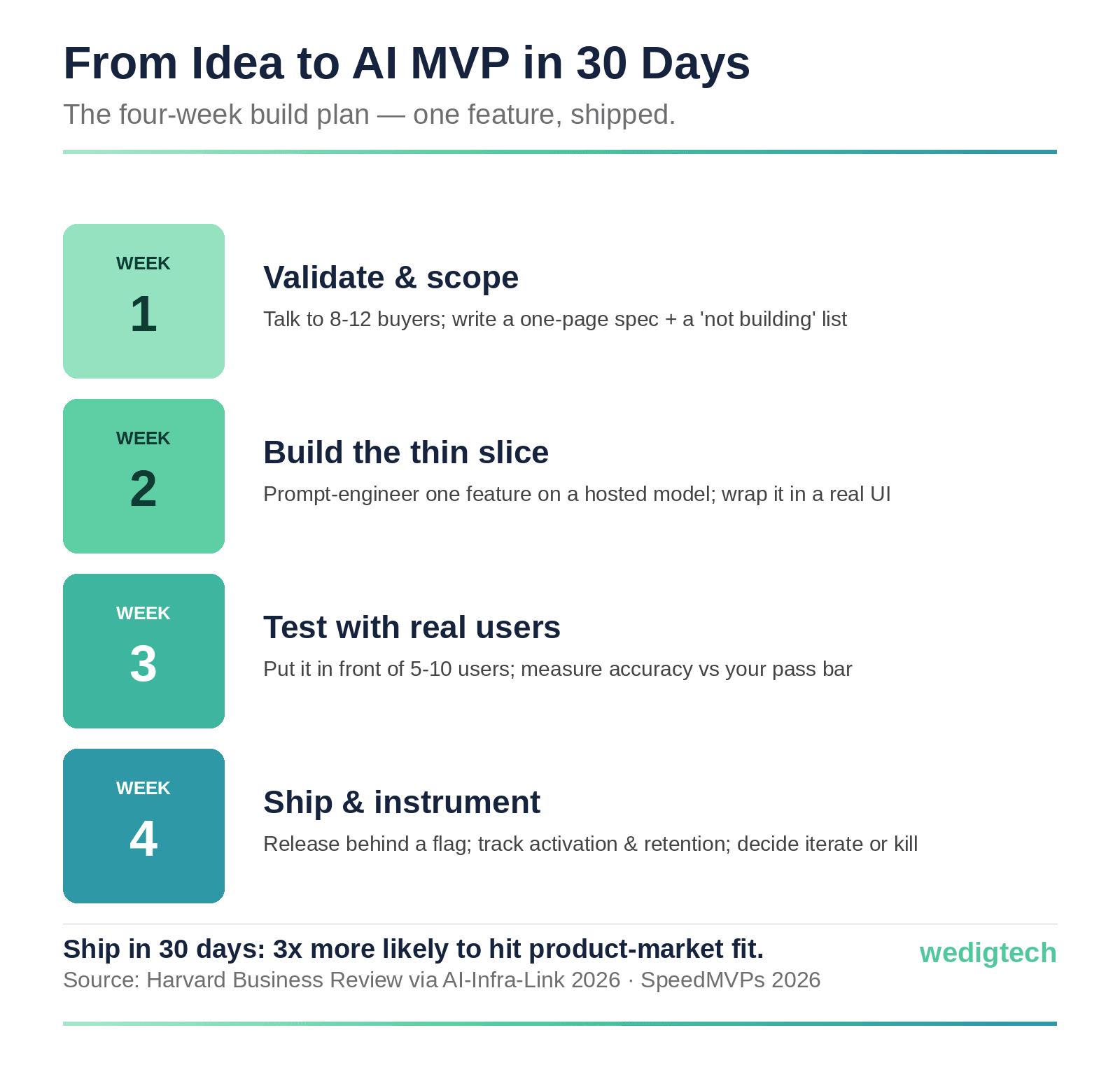
The four-week plan — validate, build a thin slice, test, ship.
The 30-Day Playbook, Week by Week
Week 1 — Validate & scope (zero code)
Do not write a line of code this week. The mistake almost every first-time builder makes is starting at the build stage before validation has answers, as SpeedMVPs (2026) puts it. Instead: (1) Talk to 8-12 people in your target market and confirm they solve this problem today in a slow or manual way. (2) Write a one-sentence problem statement. (3) Write a one-page spec — one user persona and their core job, the 5-7 step core loop, the 3-5 must-have screens, and one success metric you'll measure in the first 7 days after launch. (4) Write a 'not building' list — every feature you are explicitly cutting. You are done when a stranger could read the spec and know exactly what to build.
Week 2 — Build the thin slice
Now build, but only the core. Two decisions keep you on schedule. First, use a hosted model — the vast majority of AI MVPs in 2026 are best served by a hosted model like Claude or GPT called through an API; custom model training is almost never the right first move and is the fastest way to blow the timeline, per SpeedMVPs (2026). Second, do not ship a blank chat box — the worst AI UX is a text field that turns your user into a prompt engineer. Build a standard, intuitive interface with a clear action ('Audit this contract'), and generate the AI prompt invisibly in the backend, as SEM Nexus (2026) advises. Get one workflow working end to end. Prompt engineering will get you roughly 90% of the desired behaviour without any custom modelling.
Week 3 — Test with real users
Put the thin slice in front of 5-10 real target users. This week has two jobs. First, measure it against the accuracy bar you defined — does the output meet the quality your users will actually tolerate for this task? Second, add basic guardrails against prompt injection so a malicious user can't trick the model into leaking data or misbehaving. Instrument the core action so you can see activation. You are done when you've had at least five real user conversations and can name the top three friction points with evidence — events plus quotes, not opinions.
Week 4 — Ship & instrument
Release the MVP to a segment of real users, behind a feature flag so you can control the rollout and roll back instantly if needed. Add billing only if charging is part of the hypothesis you must validate now; otherwise test usage and retention first. Then instrument the four metrics that tell you the truth: activation rate, day-7 and day-30 retention, feature usage per session, and a satisfaction score at week two. At the end of the 30 days you have a real product in real hands, generating the data that tells you whether to iterate or kill — which is the entire point.
Week | Goal | The exact actions | Done when |
1 | Validate & scope | 8-12 buyer interviews; one-sentence problem; one-page spec; 'not building' list | A stranger could build from your spec |
2 | Build the thin slice | Hosted model via API; one workflow end-to-end; real UI, not a chat box | The core action works once, reliably |
3 | Test with real users | 5-10 users; measure vs accuracy bar; add guardrails; instrument activation | Top 3 friction points named with evidence |
4 | Ship & instrument | Release behind a flag; add billing only if testing it; track activation & retention | Real users + real data to decide next |
What to Do This Week
If you have an AI idea sitting in a doc, do these three things now. First, list 10 people you can talk to in your target market this week, and book three of those conversations — validation starts today, not after you've built. Second, write the one-page spec and the 'not building' list; if you cannot fit the MVP on one page, it is too big for 30 days. Third, pick your hosted model and confirm you can call it through an API to produce the core output once, by hand, in a script — before building any UI around it. Those three actions are Week 1, and they are finishable this week.
The discipline the whole playbook enforces is the same one the data rewards: one feature, shipped fast, validated with real users. Everything that stretches the timeline — a second feature, a custom model, a polished design before validation — is the thing that lowers your odds.
Where Wedigtech Comes In
Shipping an AI MVP in 30 days is an AI product innovation problem, and it is exactly what Wedigtech does — it builds and ships AI products. Wedigtech does not hand over a spec and wish you luck; it runs the build with you: scoping the single feature, standing up the hosted-model architecture and guardrails, building the thin product, and instrumenting it so you get real data by day 30. The result is a shipped MVP, not a backlog item waiting on an AI hire you have not made.
Was this helpful?
Ready to architect your next stage of growth?
Partner with wedigtech and turn ambition into compounding, measurable outcomes.
More from Insights
View All
How Smart Brands Use AI for Marketing in 2026 (Case Study + Playbook)
How new-age brands use AI for marketing — the six core plays, a deep case study of Spotify's AI marketing engine, the real learning for everyone else, and how to build it.
Read More
100+ AI Tools for B2B SaaS Founders (Organised by Use)
A categorised directory of 100+ AI tools for B2B SaaS founders — for content, SEO, sales, support, coding, automation, analytics and more — with what each one is best for.
Read More
The AI Features Every Modern Pharma App Should Have
The AI features a pharma company can build into its app — from smart adherence and an AI assistant to drug-interaction safety and risk prediction — the business value of each, and how to build them compliantly.
Read More