Aug 25, 2026
Why Your B2B SaaS Gets Traffic But No Demo Bookings in 2026
The Traffic Isn't the Problem
It is one of the most frustrating patterns in B2B SaaS: the analytics look healthy, sessions are climbing, the content is landing — and the demo calendar stays empty. You are paying for traffic that arrives, looks around, and leaves without ever raising a hand.
The instinct is to buy more traffic. That instinct is almost always wrong. When you have traffic but no demo bookings, the leak is rarely at the top of the funnel. It is in the stages between the visit and the booked meeting — and those stages are far cheaper to fix than the traffic is to grow.
The direct answer: your demo booking funnel is leaking at a specific, findable stage. Once you know which one, the fix is usually a matter of friction, clarity, or speed — not budget. Here is where the leaks happen and how to close each one.
What the B2B SaaS Demo Booking Funnel Actually Converts
Most founders have no benchmark for what a healthy funnel looks like, so they cannot tell a traffic problem from a conversion problem. The numbers are clearer than you would expect. B2B SaaS companies typically convert 2 to 5% of visitors into a demo request, while the top 10% convert 8 to 15% — a 3 to 5x difference on the same traffic, according to First Page Sage and Varos 2026 benchmark data. The median B2B SaaS landing page converts around 3.8% (Unbounce 2026).
Further down, the gap widens. Analysis of over one million inbound form submissions across a full year found the median qualified-to-booked rate sits at 62%, while the top 10% of companies book nearly 8 out of 10 qualified leads, according to RevenueHero's 2026 demo funnel benchmarks. The difference between 40% and 78% on the same traffic and the same leads comes down to what happens in the 30 seconds after someone fills out your form.
That single insight reframes the whole problem. You do not have a traffic problem. You have a form-to-booked problem, a visitor-to-lead problem, or a qualification problem — and each one has a different fix.
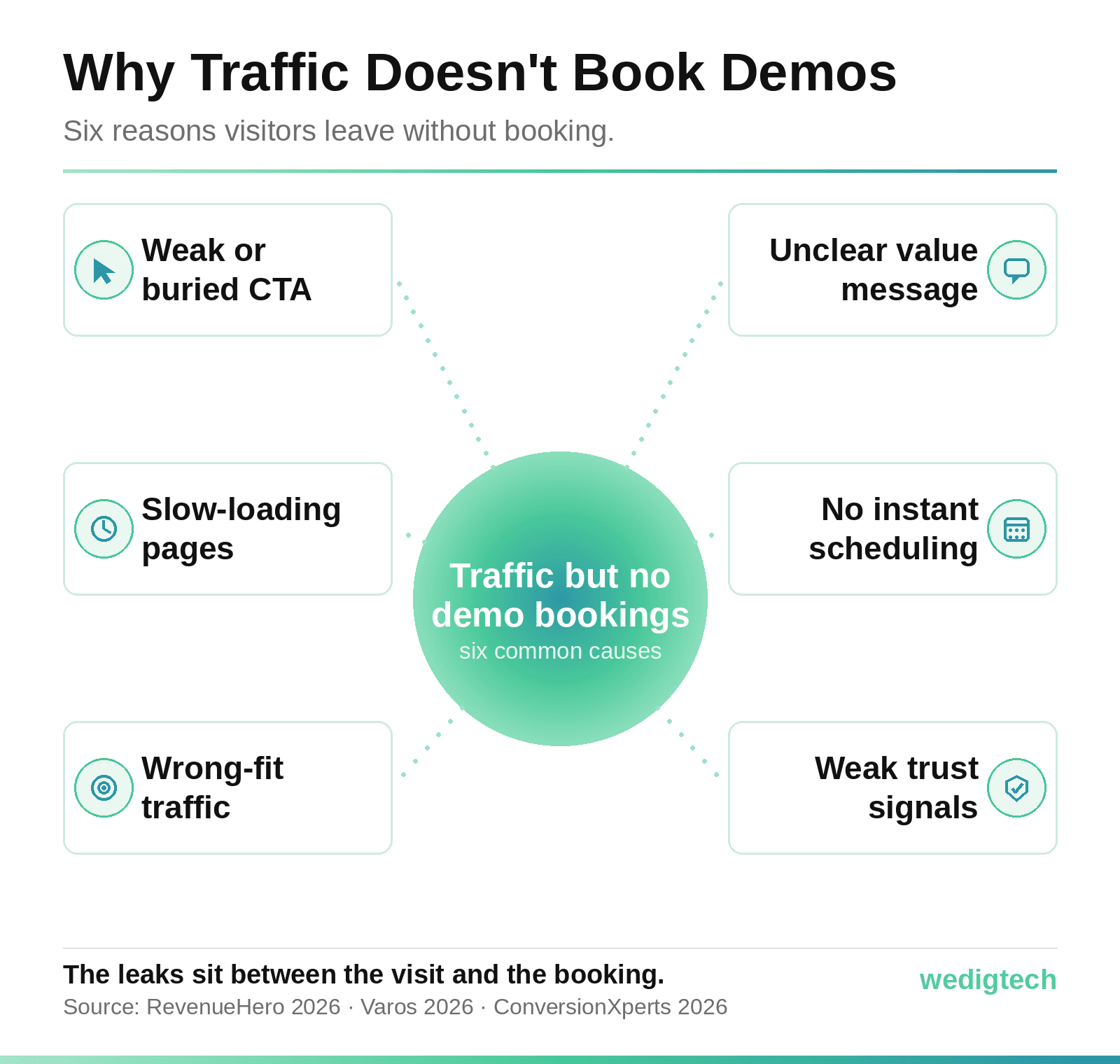
The demo booking funnel — where B2B SaaS traffic leaks before it becomes a booked meeting.
The Demo Booking Leak Audit
Run your own funnel against this table. For each stage, find your rate, compare it to the median, and apply the fix for the stage where you leak most. This is the fastest way to turn traffic into demo bookings without spending a rupee more on acquisition.
The compounding math is the part worth sitting with. A 2x improvement at each of four funnel stages creates a 16x total pipeline increase from the same traffic, according to GrowthSpree's 2026 funnel analysis. You do not need more visitors. You need to stop losing the ones you already have.
Where AI Closes the Leak Fastest
The single most expensive leak — the qualified-to-booked stage — is also the one AI closes most directly, because the whole problem is speed and consistency, and those are exactly what a human handoff cannot guarantee at scale.
The mechanism is simple. Intent decays fast: an 80% booking probability in the first minute can drop to 40% by the next day (RevenueHero 2026). Every hour of delay compounds the loss. When a human review step sits between the form fill and the calendar invite, that delay is built into the process. An AI qualification-and-routing layer removes it — qualifying the lead against ICP rules and surfacing a calendar in real time, with no SDR bottleneck. Teams using AI to automate their lead operations report 30 to 50% increases in conversion within the first month, primarily by eliminating delay and human error in the handoff from marketing to sales, according to SQ Magazine's 2026 marketing automation report.
This is not about replacing the sales team. It is about making sure the sales team only ever talks to leads who are already qualified and already booked — instead of spending their day chasing form fills that went cold hours ago. The AI handles the speed. The humans handle the conversation.
What Fixing the Leak Is Worth
The revenue math makes the priority obvious. If you sit at 40% qualified-to-booked today and reach the 62% median, that is 22 more meetings per 100 qualified leads. Reach the top-tier 78% and you have nearly doubled your pipeline from the same inbound volume, on the same spend, according to RevenueHero 2026. Yet only 8% of top B2B SaaS companies currently offer instant scheduling on their site (ConversionXperts 2026) — which means the single highest-leverage fix is still wide open for most teams.
The brands winning the demo game in 2026 are not the ones with the most traffic. They are the ones who found their leak, closed it with less friction and more speed, and turned the visitors they already had into booked meetings.
From a Leaking Funnel to a Booking System
Finding the leak is the first step. Closing it permanently is a systems problem — connecting the page, the form, the qualification logic, the calendar, and the follow-up into one flow that converts without a human holding it together. Most B2B SaaS teams have all the pieces; what they lack is the system that makes them work as one, with the speed the intent window demands.
Wedigtech's Growth System is built to design and install exactly that — the demo booking engine that turns existing traffic into qualified, booked meetings: intent-matched pages, friction-audited forms, AI qualification and routing, and instant scheduling, wired into one system. Because Wedigtech takes equity in the outcome, the system is built to keep compounding after Month 6 — a booking engine that gets sharper as it runs, not a one-time fix that decays the moment the project ends.
Was this helpful?
Ready to architect your next stage of growth?
Partner with wedigtech and turn ambition into compounding, measurable outcomes.
More from Insights
View All

The Best AI Hiring Platforms in 2026 (and How to Actually Pick One)
A practical guide to the top AI hiring platforms in 2026 — the best tools for sourcing, screening, assessment and interviewing, the end-to-end vs best-of-breed decision, and how to choose and implement the right one.
Read More
The Founder's Figma Playbook: Design and Test Your Product Before You Build
A practical playbook for how founders use Figma to design great products: the exact workflow, how to use Figma Make and Dev Mode, and how to test your product before you write a line of code.
Read More
ClickUp Brain AI for Founders: 10 Use Cases, the AI Notetaker, and Why It Replaces Your Whole Stack
How ClickUp Brain AI helps founders and enterprises: the project-visibility problem it solves, 10 real use cases of Brain AI, exactly how to use the AI Notetaker, and why ClickUp replaces multiple tools.
Read More